In reviewing immuno-inclusivity practices, a recurring theme is that collective and systemic solutions are often more effective at addressing shared problems than individual actions. In workplace health & safety, this is illustrated by a framework called the Prevention Triangle.
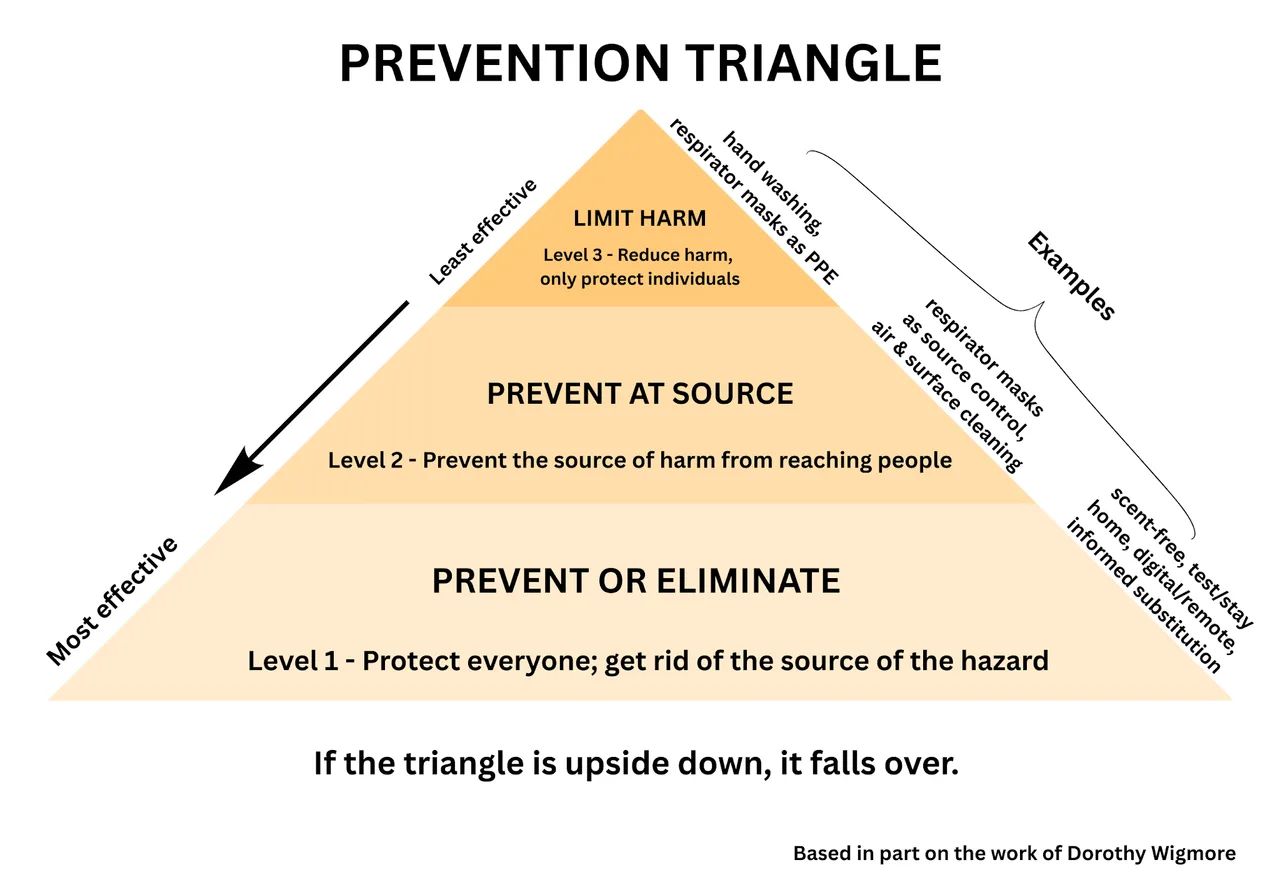
This approach prioritizes preventing hazards rather than simply controlling them, and stopping hazards at the source where possible. It also highlights that no single solution works for everything.
The Prevention Triangle operates on three levels. At the foundation, Level 1 protects everyone by removing hazards or avoiding the introduction of new ones (e.g., testing for illnesses/staying home when sick, remote and digital work, scent-free environments, and substituting products). Level 2 applies when the hazard can’t be removed, but it can be prevented from reaching most people (e.g., through collective solutions and engineering controls such as ventilation and air filtration, cleaning and disinfecting surfaces, and policies to wear respirator masks as source control). At Level 3, the focus shifts to limiting harm to individuals (e.g., hand washing, wearing respirator masks as personal protection, and other individual behaviours).
When hazards may exist but are not fully understood, experts emphasize following the precautionary principle: a foundational framework of health and environmental decision-making that can be summed up as “better safe than sorry.”Footnote 126
Immuno-inclusivity requires a layered approach—multiple steps, options, and solutions to provide the most effective protection. One way of illustrating this is the “Swiss Cheese” metaphor.
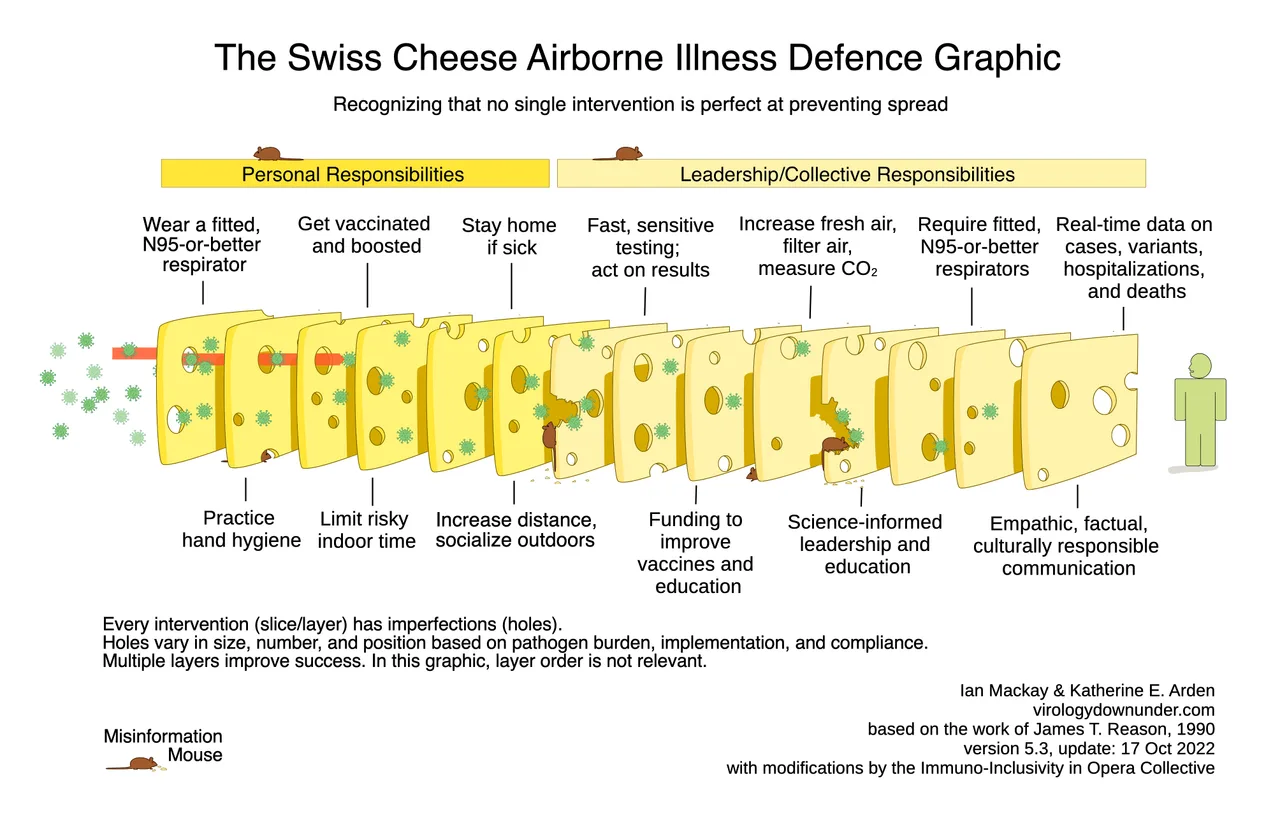
By closing policy gaps, using the right tools, and building on proven models, the performing arts sector has the opportunity to move forward and improve accessibility, sustainability, and wellbeing for everyone.
Learn more:
- Prevention principles | Wigmorising
- 10 principles of disability justice | Sins Invalid
Footnotes (3)
- “Prevention Principles,” Wigmorising, accessed July 15, 2026, https://www.wigmorising.ca/prevention-principles/; “Health and Safety Prevention and Controls,” Occupational Health Clinics for Ontario Workers Inc., accessed July 15, 2026, https://www.ohcow.on.ca/posts/health-safety-prevention-controls/. Back to text
- “Precautionary Principle: The Wingspread Statement,” Collaborative for Health & Environment, accessed July 4, 2026, https://www.healthandenvironment.org/resources/resource-library/eh-history/precautionary-principle-the-wingspread-statement; Canadian Aerosol Transmission Coalition, Proposals to Strengthen, 2–3. Back to text
- Ian M. Mackay, The Swiss Cheese Respiratory Virus Defence v.5.3 (Figshare, 2020, accessed July 15, 2026), https://doi.org/10.6084/m9.figshare.13082618.v26; “The Swiss Cheese Graphic That Went Viral,” Virology Down Under, accessed September 10, 2026, https://virologydownunder.com/the-swiss-cheese-infographic-that-went-viral/. Back to text