“Vocologists and singing voice instructors . . . should be aware that the amount of time a singer can practice or perform in one sitting may decrease substantially following a SARS-CoV-2 infection.”
- Dove et al., Journal of Voice (2022)Footnote 61
COVID and Long COVID can have specific implications for singers and other professionals who often rely on their voices (e.g., instructors, coaches, directors, actors, stage managers). Amidst 200+ potential symptoms, from muscle weakness to memory loss,Footnote 62 respiratory symptoms are common, and can cause significant voice issues.Footnote 63 Research suggests 25% of COVID-19 patients are impacted vocally, and approximately 70% of those issues become long-lasting.Footnote 64
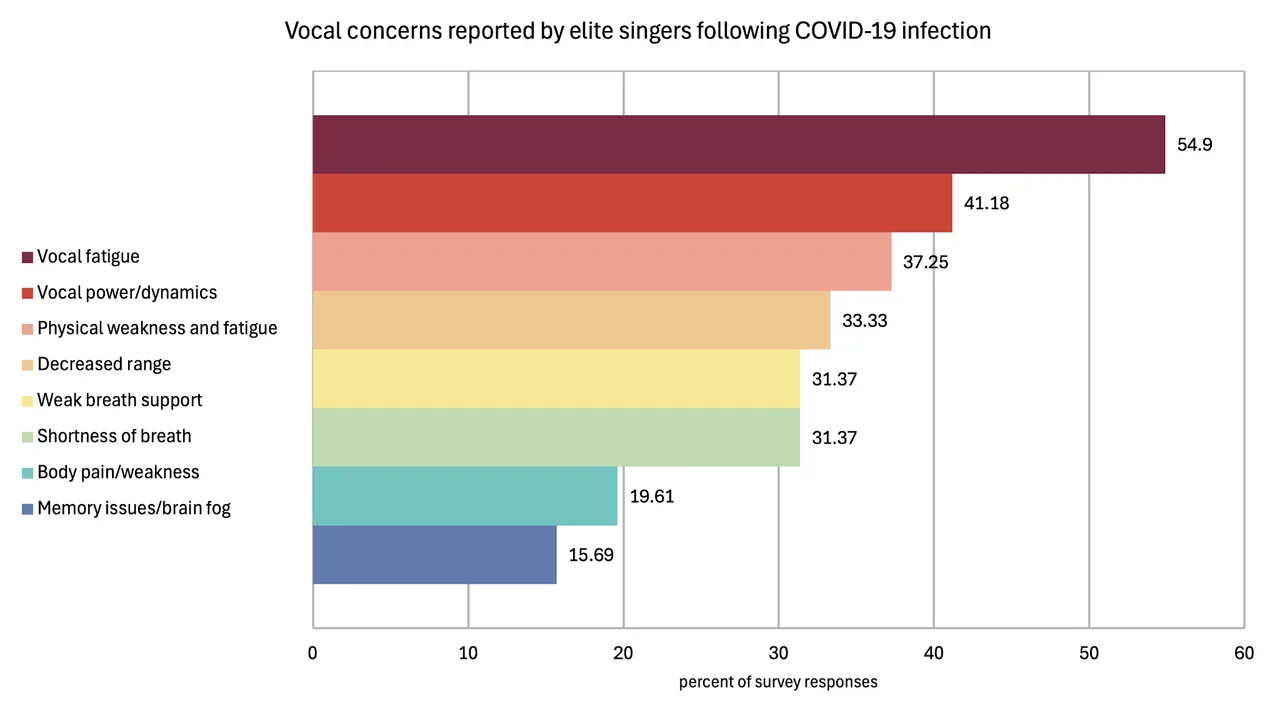
Singers have described drastic vocal changes, saying they “lost about an octave,” “can hardly do a full phrase,” and felt that “it's like learning to sing all over again.” These vocal changes caused economic impacts: “Since I've been unable to work due to this sickness, paying for voice lessons again . . . it's like going into debt all over again.”Footnote 66 As with other aspects of Long COVID, these issues disproportionately affect those assigned female at birth.Footnote 67 Influenza and the common cold can also cause nerve damage to the larynx, although COVID-19 carries increased risks.Footnote 68
“Singers and their teachers need to be aware of this risk and continue to take extra measures to avoid getting sick.”
- Emerich and Reed, Journal of Singing (2025)
Learn more:
- Vocal neuropathy from COVID-19 infection in an operatic soprano | Emerich & Reed, Journal of Singing
- “I pretty much haven't worked since 2020”: How Long COVID has harmed musicians and DJs | Music Radar
- Occupational voice loss | Hazards Magazine
Footnotes (8)
- Sophia Dove et al., “Singing Voice Symptomatology Following Presumed SARS-CoV-2 Infection,” Journal of Voice 39, no. 3 (2025): 853.e16, https://doi.org/10.1016/j.jvoice.2022.11.012. Back to text
- National Academies of Sciences, Engineering, and Medicine, A Long COVID Definition, 9, 28, 57. Back to text
- Debra Jean Phyland, “Singing In and Out of COVID,” Respirology 28, no. 1 (2023): 17–19, https://doi.org/10.1111/resp.14424; Regina Helena Garcia Martins et al., “Dysphonia and COVID-19: A Review,” Journal of Voice (2025), https://doi.org/10.1016/j.jvoice.2024.11.034; Clara Espina González et al., “Dysphonia and Other Voice Alterations Associated with COVID-19: Systematic Review,” Acta Otorrinolaringologica (English Edition) 75, no. 4 (2024): 257, https://doi.org/10.1016/j.otoeng.2024.02.005; David Meyer et al., “Reentry Following COVID-19: Concerns for Singers,” Journal of Singing 78, no. 2 (2021): 211–232, https://doi.org/10.53830/VAPD6085; Kate A. Emerich and Ona Reed, “Vocal Neuropathy: A Case Presentation of Voice Consequences from COVID-19 Infection in an Operatic Soprano,” Journal of Singing 82, no. 2 (2025): 187–191, https://dx.doi.org/10.53830/sing.00168; Dylan Vance et al., “COVID-19: Impact on the Musician and Returning to Singing; A Literature Review,” Journal of Voice 37, no. 2 (2023): 292.e1–292.e8, https://doi.org/10.1016/j.jvoice.2020.12.042. Back to text
- Chung-Wei Lin, “COVID-Related Dysphonia and Persistent Long-COVID Voice Sequelae: A Systematic Review and Meta-Analysis,” American Journal of Otolaryngology 44, no. 5 (2023): 103950, https://doi.org/10.1016/j.amjoto.2023.103950. Back to text
- Wendy LeBorgne, “COVID-19 Long-Term Impact on Elite Vocal Athletes: Initial Survey Results,” National Association of Teachers of Singing, streamed live on March 12, 2021, YouTube video, 41:56, https://www.youtube.com/live/c6sfk7s0dG0. Back to text
- Dove et al., “Singing Voice Symptomatology,” 853.e14. Back to text
- Lin, “COVID-Related Dysphonias,” 6. Back to text
- Emerich and Reed, “Vocal Neuropathy,” 187–91. Back to text