“There is no such thing as a SARS-CoV-2 infection that does NOT have prolonged consequences.”
- Dr. David Putrino, Mt. Sinai COVID SpecialistFootnote 40
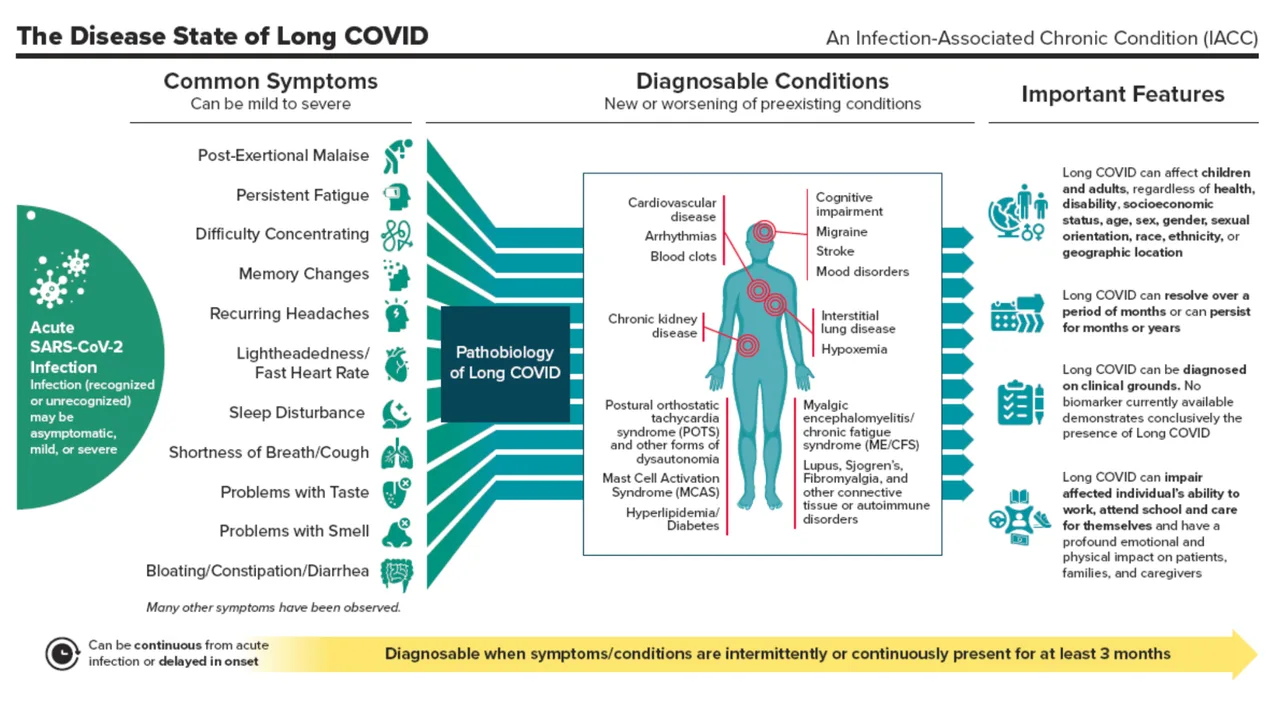
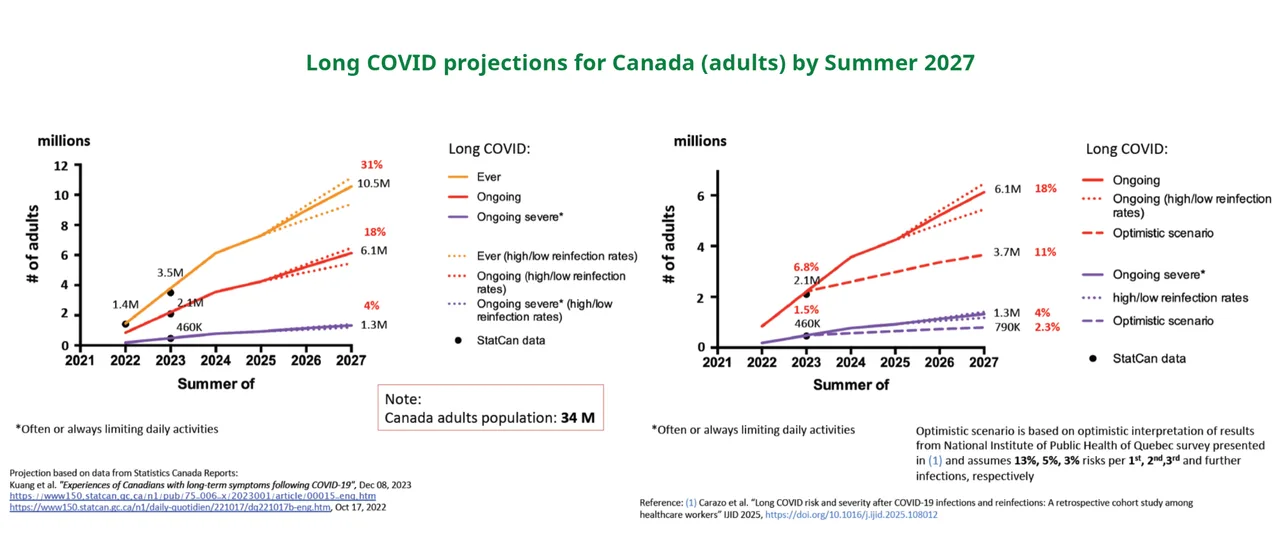
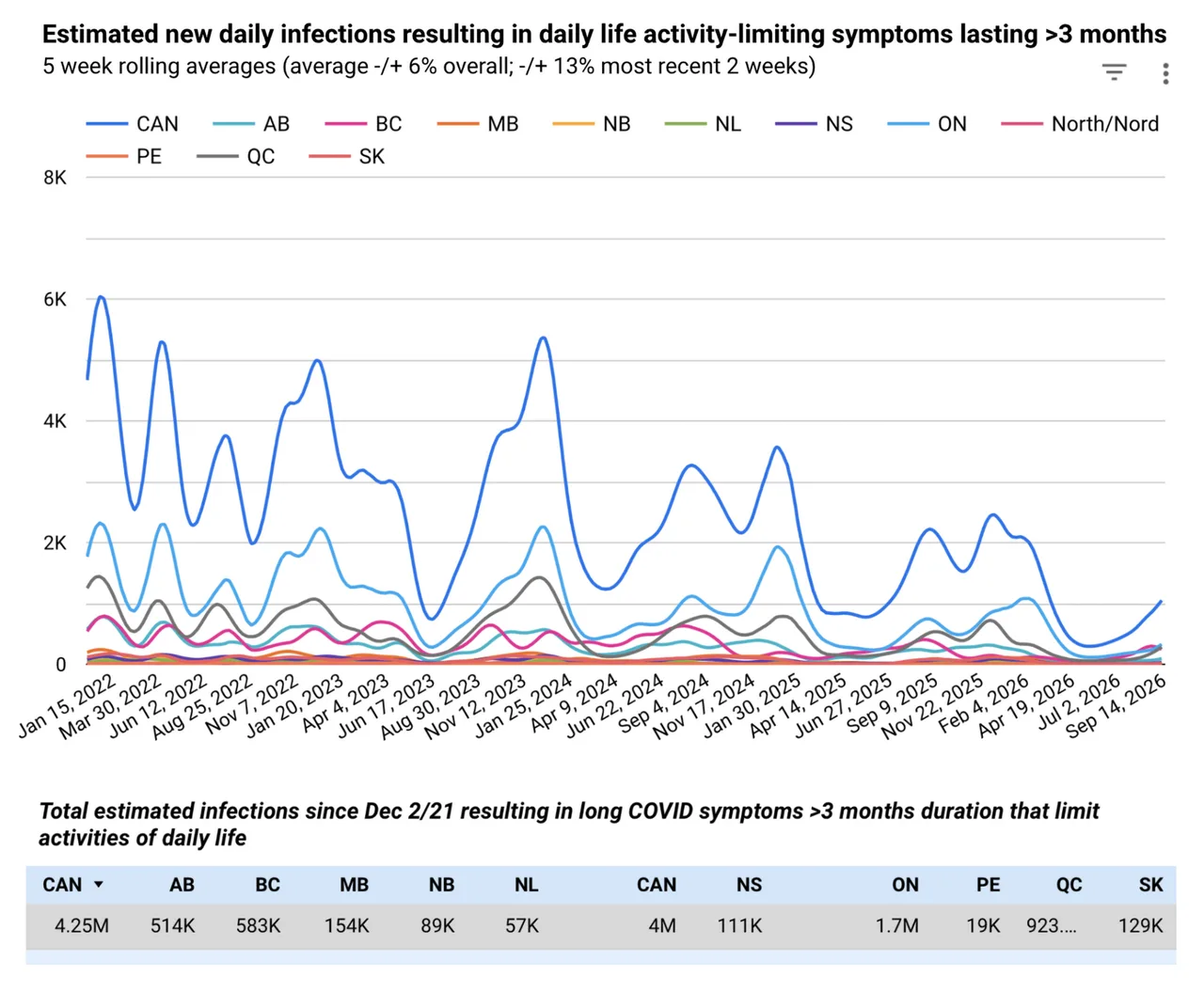
Repeated COVID-19 infections are linked to increased risks of other serious illness (e.g., heart attacks,Footnote 42 strokes,Footnote 43 dementia,Footnote 44 auto-immune diseasesFootnote 45) and can lead to long-term disability.Footnote 46 New research demonstrates COVID-19 may cause changes in people’s immune systems, painting the resurgence of many illnesses since 2020 in a troubling light.Footnote 47 By 2023, at least 1 in 9 Canadians had developed long-term health issues after a COVID infection, referred to as “Long COVID.”Footnote 48 Global Long COVID estimates at the end of 2023 totalled 400 million people.Footnote 49
While Long COVID is relatively new, many other infectious illnesses have long been known to cause long-term health effects.Footnote 50 This can result in a loss of ability to work and labour shortages impacting the economy.Footnote 51 One study finds that 46% of people with Long COVID cannot work,Footnote 52 while US data shows 140,000 more health-related absences per month since the start of the pandemic.Footnote 53 Over the next decade, Long COVID is projected to cost member countries of the Organisation for Economic Co-Operation and Development (OECD) $135 billion US per year in economic losses, not including medical costs.Footnote 54
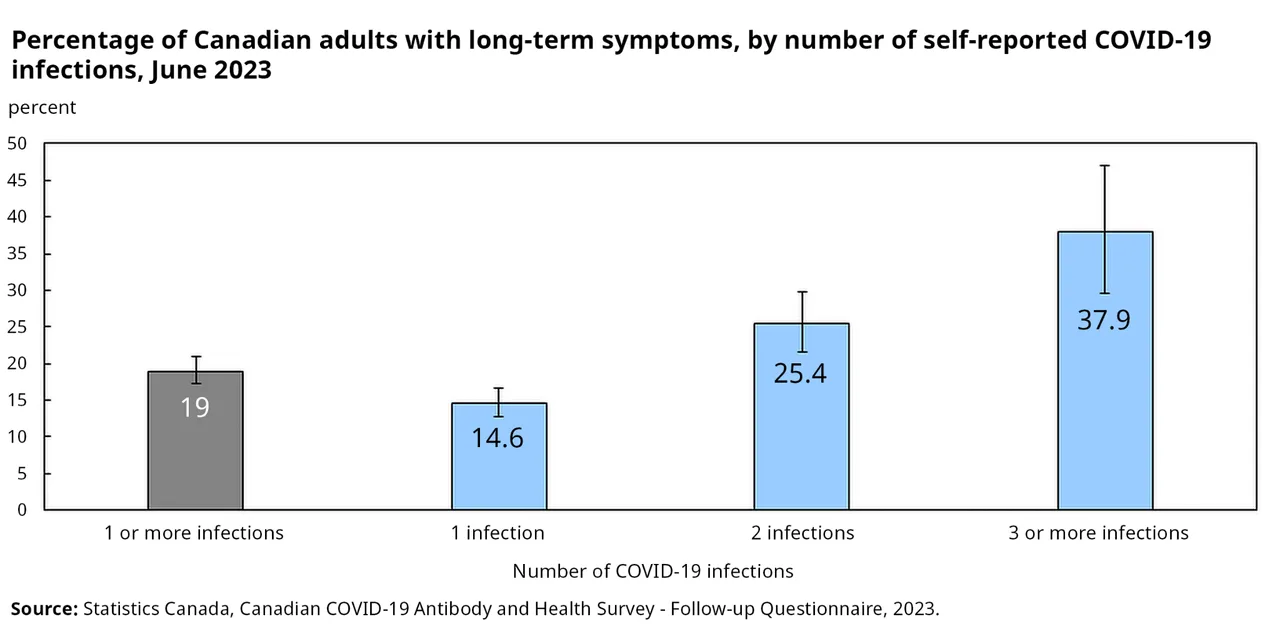
The odds of developing Long COVID rise with each infection, affecting 37.9% of people by their third infection.Footnote 55 Canada's Office of the Chief Science Advisor has described Long COVID as a potential mass-disabling event,Footnote 56 emphasizing “gaps in public messaging,” the need to support people with Long COVID, and the importance of preventing COVID and thus Long COVID through protective measures (masks, clean air, isolating when sick) with support from institutions and employers.Footnote 57
Learn more:
- Dealing with the fallout: Post-COVID condition and its continued impact | Office of the Chief Science Advisor of Canada
- Long COVID The Answers | Kojala Medical
- The lingering shadow of epidemics: post-acute sequelae across history | Miller et al., Trends in Immunology
Footnotes (21)
- Andrew Nikiforuk, “As COVID Surges, the High Price of Viral Denial,” The Tyee, September 3, 2024, https://thetyee.ca/Analysis/2024/09/03/COVID-Surge-High-Price-Viral-Denial. Back to text
- National Academies of Sciences, Engineering, and Medicine, A Long COVID Definition: A Chronic, Systemic Disease State with Profound Consequences (The National Academies Press, 2024), https://doi.org/10.17226/27768. Back to text
“Post-Covid and Long Covid Cardiovascular Risks,” Canadian Covid Society, last modified March 9, 2026,
https://covidsociety.ca/priorities/long-covid/cardiovascular-risks/; Vassilios S. Vassiliou et al., “Cardiovascular Disease Prevention and Management in COVID-19: A Clinical Consensus Statement of the European Association of Preventive Cardiology, the European Association of Cardiovascular Imaging, the Association of Cardiovascular Nursing & Allied Professions, the European Association of Percutaneous Cardiovascular Interventions, and the Heart Failure Association of the ESC,” European Journal of Preventive Cardiology (2025), https://doi.org/10.1093/eurjpc/zwaf540.
Back to text- Marco Zuin et al., “Risk of Ischemic Stroke in Patients Recovered From COVID-19 Infection: A Systematic Review and Meta-Analysis,” European Stroke Journal 8, no. 4 (2023): 915–22, https://doi.org/10.1177/23969873231190432. Back to text
- Maxime Taquet et al., “Neurological and Psychiatric Risk Trajectories After SARS-CoV-2 Infection: An Analysis of 2-Year Retrospective Cohort Studies Including 1 284 437 Patients,” The Lancet Psychiatry 9, no. 10 (2022): 816, https://doi.org/10.1016/S2215-0366(22)00260-7. Back to text
- Chih-Chen Tzang et al., “Association Between COVID-19 and New-Onset Autoimmune Diseases: Updated Systematic Review and Meta-Analysis of 97 Million Individuals,” Clinical Reviews in Allergy and Immunology 68 (2025), https://doi.org/10.1007/s12016-025-09124-4. Back to text
- Hannah E. Davis et al., “Long COVID: Major Findings, Mechanisms and Recommendations,” Nature Review Microbiology 21 (2023): 134, https://doi.org/10.1038/s41579-022-00846-2; Paul A. Volberding et al., eds., Long-Term Health Effects of COVID-19: Disability and Function Following SARS-CoV-2 Infection (National Academies of Sciences, Engineering, and Medicine, 2024), 217–18, https://doi.org/10.17226/27756. Back to text
- Zhengqi Jiang et al., “Persistent Attenuation of Lymphocyte Subsets After Mass SARS-CoV-2 Infection,” International Journal of Infectious Diseases 163 (2026): 108287, https://doi.org/10.1016/j.ijid.2025.108287; Bernhard Kratzer et al., “Differential Decline of SARS-CoV-2-Specific Antibody Levels, Innate and Adaptive Immune Cells, and Shift of Th1/inflammatory to Th2 Serum Cytokine Levels Long After First COVID-19,” Allergy 79, no. 9 (2024): 2482–2501, https://doi.org/10.1111/all.16210; Nick Tsergas, “Why Scientists are Rethinking the Immune Effects of SARS-CoV-2,” BMJ 390 (2025): r1733, https://doi.org/10.1136/bmj.r1733. Back to text
- Sianne Kuang et al., Insights on Canadian Society: Experiences of Canadians with Long-Term Symptoms Following COVID-19, Catalogue no. 75-006-X (Statistics Canada, 2023): 4, https://www150.statcan.gc.ca/n1/pub/75-006-x/2023001/article/00015-eng.htm. Back to text
- Ziyad Al-Aly et al., “Long COVID Science,” 2150. Back to text
- Christine M. Miller, “The Lingering Shadow of Epidemics: Post-Acute Sequelae Across History,” Trends in Immunology 47, no. 1 (2026): 10–15, https://doi.org/10.1016/j.it.2025.10.010. Back to text
- Miguel Gallegos, “The Impact of Long Covid on People's Capacity to Work,” Annals of Work Exposures and Health 67, no. 7 (2023): 801–4, https://doi.org/10.1093/annweh/wxad029; Katie Bach, “Is ‘Long Covid’ Worsening the Labour Shortage?,” Brookings, January 11, 2022, https://www.brookings.edu/articles/is-long-covid-worsening-the-labor-shortage/; Kenny Cheng, “Long COVID Keeps People Out of Work and Hurts the Economy,” Yale Medicine, December 23, 2024, https://www.yalemedicine.org/news/long-covid-keeps-people-out-of-work-and-hurts-the-economy. Back to text
- Céline J.A. van Bilsen et al., “Workforce Exit and Work Productivity Loss in Adults With and Without Post-COVID-19 Condition: The PRIME Post-COVID Cohort Study,” International Journal of Infectious Diseases 170 (2026), https://doi.org/10.1016/j.ijid.2026.108913. Back to text
- Julia M. Dennett et al., “Enduring Outcomes of COVID-19 Work Absences on the US Labor Market,” JAMA Network Open 8, no. 10 (2025): e2536635, https://doi.org/10.1001/jamanetworkopen.2025.36635. Back to text
- OECD, Addressing the Costs and Care for Long COVID: The Long Shadow of the Pandemic (OECD Publishing, 2026): 29, https://doi.org/10.1787/87a0c171-en. Back to text
- Kuang et al., Experiences of Canadians, 5. Back to text
- Canada, Office of the Chief Science Advisor, Post-COVID-19 Condition in Canada: What We Know, What We Don’t Know, and a Framework for Action (Government of Canada, 2022), 38, https://science.gc.ca/site/science/en/office-chief-science-advisor/initiatives-covid-19/post-covid-19-condition-canada-what-we-know-what-we-dont-know-and-framework-action. Back to text
- Canada, Office of the Chief Science Advisor, Dealing with the Fallout: Post-COVID Condition and its Continued Impact on Individuals and Society (Government of Canada, 2024), 8, https://science.gc.ca/site/science/en/office-chief-science-advisor/initiatives-covid-19/dealing-fallout-post-covid-condition-and-its-continued-impact-individuals-and-society. Back to text
- Kuang et al., Experiences of Canadians, 5. Back to text
- Malgorzata Gasperowicz, “Long COVID Projections” (PowerPoint presentation, 3rd Canadian Symposium on Long COVID, St. John's, NL, October 21, 2025); Sara Carazo et al., “Long COVID Risk and Severity After COVID-19 Infections and Reinfections: A Retrospective Cohort Study Among Healthcare Workers,” International Journal of Infectious Diseases 159 (2025): 108012, https://doi.org/10.1016/j.ijid.2025.108012. Back to text
- COVID-19 Resources Canada, “Canadian COVID Forecast.” Back to text