Amidst the evolving hazard landscape, COVID-19 remains an ongoing threat. Wastewater data and academic modelling continue to show substantial daily infection rates, often exceeding rates earlier in the pandemic.Footnote 24 Illness surges occur throughout the year,Footnote 25 and despite reduced testing and tracking, COVID-19 has remained amongst Canada’s top official causes of death.Footnote 26 (Excess deaths since 2020 suggest a far higher unofficial toll.)Footnote 27
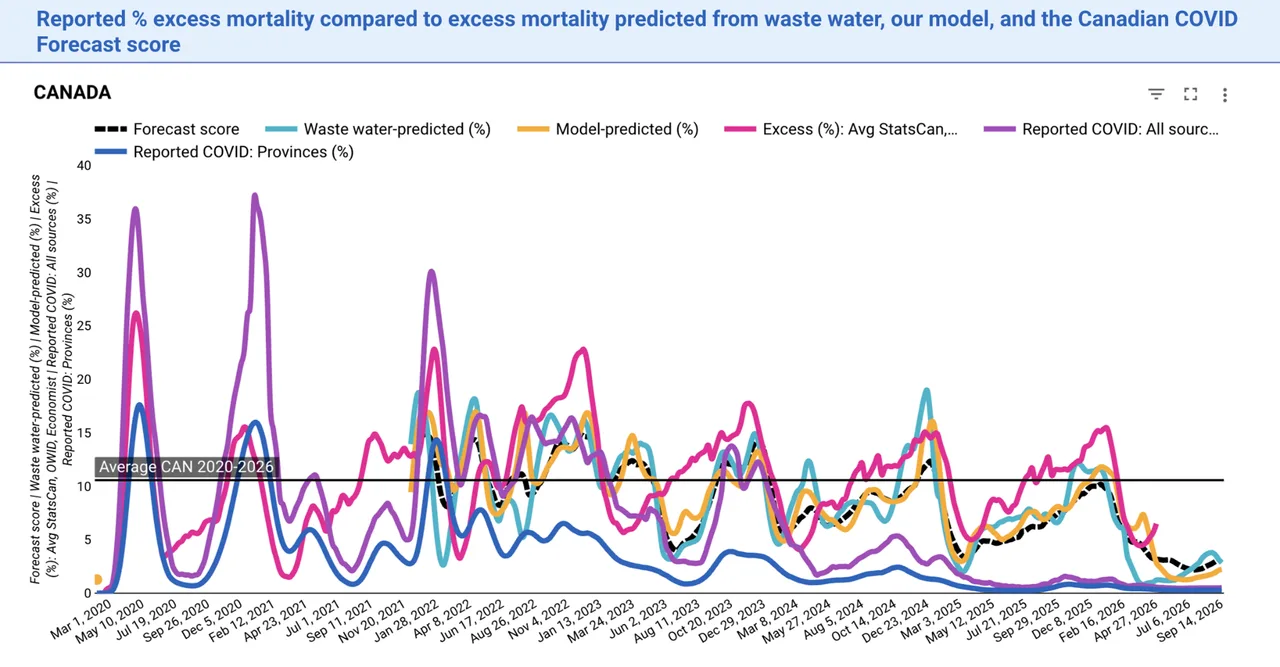
With the end of emergency declarations and many mandatory public health measures, some people now assume that COVID-19 no longer poses a risk. Yet the data is clear, as is messaging from the World Health Organization (WHO), which has continued to emphasize that “we're still in a pandemic,”Footnote 29 despite choosing to end COVID-19’s designation as a Public Health Emergency of International Concern.Footnote 30
“The worst thing any country could do now is to use [the end of our emergency declaration] as a reason to let down its guard, to dismantle the systems it has built, or to send the message to its people that COVID-19 is nothing to worry about. . . . If we all go back to how things were before COVID-19, we will have failed to learn our lessons, and we will have failed future generations.”
- Dr Tedros Adhanom Ghebreyesus, WHO Director-GeneralFootnote 31
Contributing to this lack of awareness is the fact that people can transmit COVID-19 without obvious symptoms.Footnote 32 In 2022, Statistics Canada found that “35% of people who had a current or recent infection indicated that they had never tested positive or suspected having the virus [SARS-CoV-2].”Footnote 33 Meanwhile, modelling indicates 59% of COVID-19 transmission is asymptomatic.Footnote 34
Asymptomatic transmission is common for many communicable diseases,Footnote 35 causing health & safety impacts that ripple out beyond a single workplace or event. A 2020 conference in Boston was estimated to cause a chain of over 300,000 COVID infections throughout the United States.Footnote 36 More recently, some large-scale concerts have reportedly resulted in thousands of attendee infections,Footnote 37 while other events had to be cancelled last-minute due to health issues.Footnote 38 One person’s “mild” infection may lead to someone else’s severe one, or to long-term health impacts.Footnote 39
Learn more:
- Canadian COVID forecast | COVID-19 Resources Canada
- Rampant COVID poses new challenges in the fifth year of the pandemic | Scientific American
Footnotes (16)
- “Canadian COVID Forecast,” COVID-19 Resources Canada, accessed July 8, 2026, https://covid19resources.ca/covid-hazard-index/; “PMC COVID-19 Data Dashboard,” Pandemic Mitigation Collaborative, accessed July 8, 2026, https://www.pmc19.com/data/index.php. Back to text
- Caroline Kee, “Is the US in a Summer COVID Surge? Cases Are Rising in These States,” Today, August 8, 2025, https://www.today.com/health/coronavirus/covid-2025-summer-surge-rcna218754; Katie Dangerfield & Katherine Ward, “COVID-19 Still Lacks ‘Seasonality’ 4 Years Later, Tam Warns,” Global News, December 21, 2023, https://globalnews.ca/news/10180003/covid-seasonal-theresa-tam-2023/; Lauren Pelley, “4 years later, COVID Remains a Year-Round Threat. Here’s Why This Virus Isn’t Seasonal Quite Yet,” CBC, June 8, 2024, https://www.cbc.ca/news/health/summer-cold-covid-2024-1.7227336. Back to text
- Canada, Statistics Canada, “Table 13-10-0394-01 Leading Causes of Death, Total Population, by Age Group,” Statistics Canada, accessed July 11, 2026, https://doi.org/10.25318/1310039401-eng. Back to text
- “Excess Mortality Tracker,” COVID-19 Resources Canada, last modified November 14, 2025, https://covid19resources.ca/public/excess-mortality-tracker/; “The Pandemic’s True Death Toll,” The Economist, October 25, 2022, https://www.economist.com/graphic-detail/coronavirus-excess-deaths-estimates. Back to text
- COVID-19 Resources Canada, “Canadian COVID Forecast.” Back to text
- Meghan Bartels, “Rampant COVID Poses New Challenges in the Fifth Year of the Pandemic,” Scientific American, February 6, 2024, https://www.scientificamerican.com/article/rampant-covid-poses-new-challenges-in-the-fifth-year-of-the-pandemic/. Back to text
- Fergus Brown, “The WHO Has Not Declared the Covid-19 Pandemic Over,” Full Fact, June 16, 2023, https://fullfact.org/health/who-covid-pandemic-over/; Erin Prater, “COVID Levels Are Up to 19 Times Higher Than Reported, WHO Says As It Warns of the Potential Dangers of Repeat Reinfection: ‘We Don’t Know Everything About This Virus,’” Fortune, January 12, 2024, https://fortune.com/well/2024/01/12/covid-jn1-pandemic-world-health-organization-warns-dangers-repeat-covid-infection-cardiac-pulmonary-neurologic/. Back to text
- “WHO Director-General’s Opening Remarks at the Media Briefing – 5 May 2023,” World Health Organization, May 5, 2023, https://www.who.int/news-room/speeches/item/who-director-general-s-opening-remarks-at-the-media-briefing---5-may-2023. Back to text
- Bing Wang et al., “Asymptomatic SARS-CoV-2 Infection by Age: A Global Systematic Review and Meta-Analysis,” The Pediatric Infectious Disease Journal 42, no. 3 (2023): 232–39, https://doi.org/10.1097/INF.0000000000003791; Anna Funk et al., “Household Transmission Dynamics of Asymptomatic SARS-CoV-2–Infected Children: A Multinational, Controlled Case-Ascertained Prospective Study,” Clinical Infectious Diseases 78, no. 6 (2024): 1522–30, https://doi.org/10.1093/cid/ciae069. Back to text
- Canada, Statistics Canada, Canadians’ Awareness of When They Have COVID-19, May to August 2022, Catalogue no. 11-001-X (Statistics Canada, 2022), https://www150.statcan.gc.ca/n1/en/daily-quotidien/221208/dq221208a-eng.pdf. Back to text
- Michael Johansson et al., “SARS-CoV-2 Transmission From People Without COVID-19 Symptoms,” JAMA Network Open 4, no. 1 (2021): e2035057, https://doi.org/10.1001/jamanetworkopen.2020.35057. Back to text
- Nabila Shaikh et al., “Asymptomatic But Infectious - The Silent Driver of Pathogen Transmission. A Pragmatic Review,” Epidemics 44 (2023):100704, https://doi.org/10.1016/j.epidem.2023.100704. Back to text
- Charles A. Taylor et al., “Livestock Plants and COVID-19 Transmission,” Proceedings of the National Academy of Sciences of the United States of America 117, no. 50 (2020): 31706–15, https://doi.org/10.1073/pnas.2010115117; Jacob E. Lemieux et al., “Phylogenetic Analysis of SARS-CoV-2 in Boston Highlights the Impact of Superspreading Events,” Science 371, no. 6529 (2020), https://pmc.ncbi.nlm.nih.gov/articles/PMC7857412/. Back to text
- AE Dee, “Taylor Swift Eras Tour in Madrid Ends With 35% of Concertgoers Contracting COVID-19 Infection,” Music Times, June 10, 2024, https://www.musictimes.com/articles/104225/20240610/taylor-swift-eras-tour-madrid-ends-35-concertgoers-contracting-covid.htm. Back to text
Sha Be Allah, “Lil Wayne Forced to Cancel Concert Due to Unspecified Illness,” The Source, August 12, 2025, https://thesource.com/2025/08/12/lil-wayne-forced-to-cancel-concert-due-to-unspecified-illness/; Clara Bajalan, “LeAnn Rimes Cancels More Shows After COVID-19 Diagnosis: Asks Fans for Prayers as She Heals,” JubileeCast, May 3, 2026, https://www.jubileecast.com/articles/36358/20260503/leann-rimes-cancels-more-concerts-covid-19-laryngitis-2026.htm;
“Illness Forces Cody Johnson to Cancel Remaining 2025 Concerts,” Country Top 40 with Fitz, October 7, 2025, https://ct40.com/illness-forces-cody-johnson-to-cancel-remaining-2025-concerts/; Stephen Andrew Galiher, “Linkin Park Cancels Concert Due to ‘Medical Issue’,” Vice, June 20, 2025, https://www.vice.com/en/article/linkin-park-cancels-concert-due-to-medical-issue/.
Back to text- Ziyad Al-Aly et al., “Long COVID Science, Research and Policy,” Nature Medicine 30 (2024): 2148–64, https://doi.org/10.1038/s41591-024-03173-6. Back to text