The performing arts sector has become increasingly aware of the need to improve equity and accessibility. Many organizations have implemented equity, diversity, and inclusion (EDI or DEI) policies with this goal in mind, yet too often, immuno-inclusivity is left out of the conversation.
Recent research highlights that “high-risk health status, which overlaps with but is not reducible to disability as conventionally understood, is an important axis of inequality.”Footnote 69 Not only that, but it is an axis that intersects with many other forms of marginalization. Indigenous and racialized people, immigrants, queer and trans people, and lower-income people all experience documented health inequities.Footnote 70 Women experience higher rates of infection-associated chronic illnesses such as Long COVID, myalgic encephalomyelitis (ME), and certain autoimmune diseases.Footnote 71 Trans and gender diverse people, bisexual people, and neurodivergent people are also at higher risk of developing Long COVID,Footnote 72 while children are disproportionately harmed by poor air quality, due to a variety of physiological factors.Footnote 73
High-risk status is not just a personal attribute, but also a structural position—one that can change over time. Heightened risk can arise from one’s profession, working conditions, socioeconomic status, or access to health information and care.Footnote 74 It can also be affected by the protections that workplaces or other institutions choose to provide—or not provide.Footnote 75
In 2022, BC’s Human Rights Commissioner stated that the removal of COVID-19 health protections has resulted in “profoundly unequal effects across society,” highlighting the marginalization of “immuno-compromised people, older people, Indigenous and racialized peoples, people with disabilities, and low-income communities.”Footnote 76 Immunocompromised people continue to die from COVID-19 at far higher rates,Footnote 77 but though some groups face disproportionate risks, nobody is no-risk.Footnote 78 It is also common to become medically higher-risk for many immune-related hazards over time, whether through aging, or from exposure to hazards that damage the body (including the immune system).Footnote 79
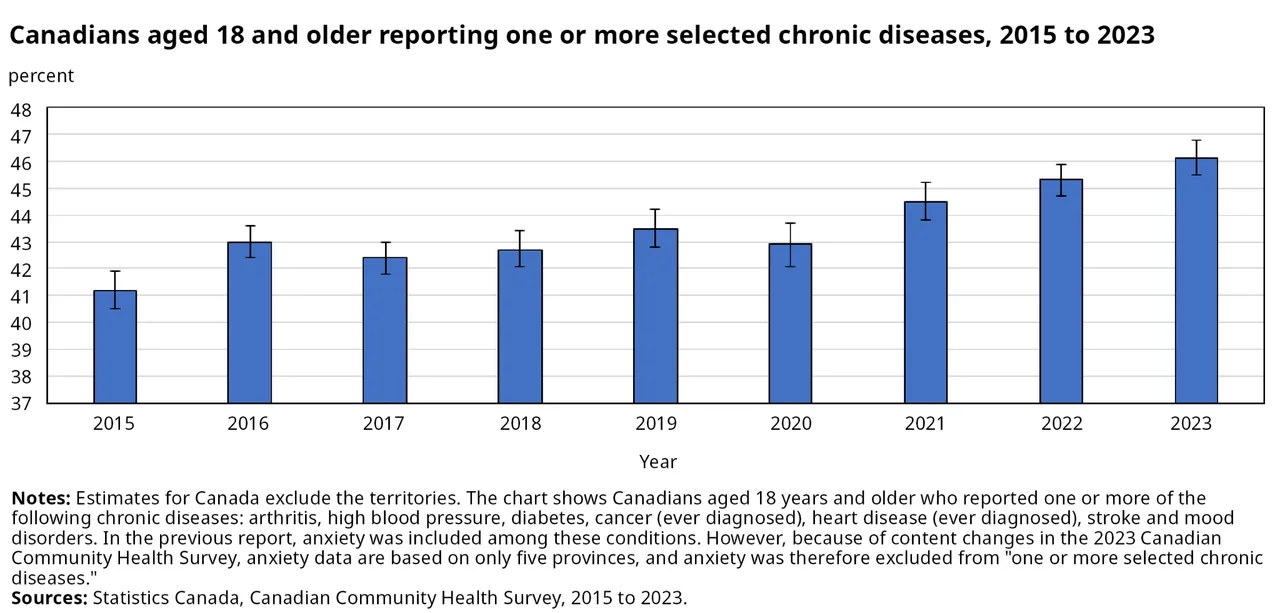
As of 2023, 46.1% of Canadian adults report having at least one major chronic disease, with rates in some provinces as high as 59%.Footnote 80 As of 2022, 27% of Canadians aged 15 or over have one or more disabilities, and that number continues to rise.Footnote 81 Meanwhile, a 2024 survey of BC arts and entertainment workers found 78% of respondents identified as marginalized, underserved, and/or vulnerable, highlighting the widespread social and structural inequities in the sector.Footnote 82 Statistically, the majority of people involved in a performing arts event (on- or off-stage) likely have risk factors for more severe health outcomes—or share a household with someone who does.
Footnotes (15)
- Sylvia Fuller et al., “The Work/Care Interface and Parents’ Mid-Pandemic Mental Health: Inequalities at the Intersection of Gender and High-Risk Household Status,” Society and Mental Health 15, no. 1 (2024): 88, https://doi.org/10.1177/21568693231223549. Back to text
- Canada, Public Health Agency of Canada, Key Health Inequalities in Canada: A National Portrait (Government of Canada, 2018), 78–79, https://www.canada.ca/en/public-health/services/publications/science-research-data/key-health-inequalities-canada-national-portrait-executive-summary.html; Kwame McKenzie, “Toronto and Peel Have Reported Race-Based and Socio-Demographic Data – Now We Need Action,” Wellesley Institute, August 13, 2020, https://www.wellesleyinstitute.com/toronto-and-peel-have-reported-race-based-and-socio-demographic-data-now-we-need-action/; Dhruv Khullar et al., “Racial/Ethnic Disparities in Post-Acute Sequelae of SARS-CoV-2 Infection in New York: An EHR-Based Cohort Study from the RECOVER Program,” Journal of General Internal Medicine 38 (2023): 1127–36, https://doi.org/10.1007/s11606-022-07997-1; National Center for Health Statistics, “Household Pulse Survey, 2022–2024: Long COVID,” U.S. Census Bureau, generated interactively, April 18, 2026, https://www.cdc.gov/nchs/covid19/pulse/long-covid.htm; Kuang et al., Experiences of Canadians, 3; Akm Alamgir et al., “Healthcare Service Needs for Refugees, Asylum Seekers and Residents With Precarious Immigration Status in Canada: A Scoping Review,” Journal of Scientific Research and Reports 31, no. 1 (2025): 118–19, https://doi.org/10.9734/jsrr/2025/v31i12752; Mei-ling Wiedmeyer et al., “How Immigration Shapes Health Disadvantages and What Healthcare Organizations Can Do to Deliver More Equitable Care,” Health Management Forum 38, no. 1 (2024): 1–7, https://doi.org/10.1177/08404704241265675. Back to text
- Dimpy P. Shah et al., “Sex Differences in Long COVID,” JAMA Network Open 8, no. 1 (2025): e2455430, https://doi.org/10.1001/jamanetworkopen.2024.55430; Inger Johanne Bakken et al., “Two Age Peaks in the Incidence of Chronic Fatigue Syndrome/Myalgic Encephalomyelitis: A Population-Based Registry Study from Norway 2008–2012,” BMC Medicine 12, no. 167 (2014): 1–6, https://doi.org/10.1186/s12916-014-0167-5; Andrew D. Bretherick et al., “Typing Myalgic Encephalomyelitis by Infection at Onset: A DecodeME study,” NIHR Open Research 3, no. 20 (2023): 2, https://doi.org/10.3310/nihropenres.134; Diane R. Dou et al., “Xist Ribonucleoproteins Promote Female Sex-Biased Autoimmunity,” Cell 187, no. 3 (2024): 733–49.e16, https://www.cell.com/cell/fulltext/S0092-8674(24)00002-3; Bruce Goldman, “Stanford Medicine-Led Study Shows Why Women are at Greater Risk of Autoimmune Disease,” Stanford Medicine, February 1, 2024, https://med.stanford.edu/news/all-news/2024/02/women-autoimmune.html. Back to text
- Jake Miller, “Studies Deepen Understanding of LGBTQ Health Disparities,” Harvard Medical School, September 13, 2024, https://hms.harvard.edu/news/studies-deepen-understanding-lgbtq-health-disparities; Landon Hughes et al., “Privately Insured Transgender People Are At Elevated Risk For Chronic Conditions Compared With Cisgender Counterparts,” Health Affairs 40, no. 9 (2021), https://www.healthaffairs.org/doi/10.1377/hlthaff.2021.00546; National Center for Health Statistics, “Household Pulse Survey, 2022–2024”; Miles Griffis, “Long COVID Is More Common in Bisexual and Trans People. The Reasons Why Are Complicated,” Them, July 27, 2022, https://www.them.us/story/long-covid-trans-and-bisexual-people-healthcare-disparities; Anna Zalewska, “Long COVID and Autism Spectrum Disorders — a Narrative Review,” Fides et Ratio 56, no. 4 (2023): 200–3, https://doi.org/10.34766/fetr.v56i4.1242; Tori Rodriguez, “ADHD Linked to Worse COVID-19 Outcomes,” Psychiatry Advisor, January 7, 2022, https://www.psychiatryadvisor.com/features/adhd-is-associated-with-greater-covid-19-symptom-severity-and-hospitalization/; Jessica Eccles, “Bendy Bodies, Bendy Brains: Insights from Bench to Bedside,” presented at The Invisible Impact of COVID-19 on Hypermobility Syndromes and Neurodivergence: Bodies, Brains and Burnout, SEDSConnective, London, UK, July 11, 2025; Nancy Doyle, “Fatigue, Brain Fog And A Racing Heart — What Doctors Are Learning About Post-COVID Neurodivergence,” Forbes, July 15, 2025, https://www.forbes.com/sites/drnancydoyle/2025/07/15/fatigue-brain-fog--and-a-racing-heart---what-doctors-are-learning-about-post-covid-neurodivergence/. Back to text
- Sathya Swarup Aithal et al., “Air Quality and Respiratory Health in Children,” Breathe 19, no. 2 (2023), https://doi.org/10.1183/20734735.0040-2023. Back to text
- Xavier St. Denis, “Sociodemographic Determinants of Occupational Risks of Exposure to COVID‐19 in Canada,” Canadian Review of Sociology 57, no. 3 (2020): 399–452, https://doi.org/10.1111/cars.12288; Benjamin Wachtler et al., “Socioeconomic Inequalities and COVID-19 — A Review of the Current International Literature,” Supplement, Journal of Health Monitoring 5, no. S7 (2020): 3–17, https://doi.org/10.25646/7059; Zhao-ya Fan et al., “Association Between Health Literacy and Mortality: A Systematic Review and Meta-Analysis,” Archives of Public Health 79, no. 1 (2021): 119, https://doi.org/10.1186/s13690-021-00648-7; Sara De Matteis, “Occupational Determinants of Long COVID in the Population-Based COVICAT Cohort,” Occupational and Environmental Medicine 82 (2025): 579–88, https://doi.org/10.1136/oemed-2025-110398; “COVID-19 Claims Data,” WorkSafeBC, last modified January 2025, https://www.worksafebc.com/en/covid-19/claims/covid-19-claims-by-industry-sector. Back to text
- Peter M. DeJonge et al., “School District Prevention Policies and Risk of COVID-19 Among In-Person K–12 Educators, Wisconsin, 2021,” American Journal of Public Health 112, no. 12 (2022): 1791–99, https://doi.org/10.2105/AJPH.2022.307095/; Mark Ferris et al., “Efficacy of FFP3 Respirators for Prevention of SARS-CoV-2 Infection in Healthcare Workers,” eLife 10 (2021): e71131, https://doi.org/10.7554/eLife.71131; “Testing and Masking Policies and Hospital-Onset Respiratory Viral Infections,” JAMA Network Open 7, no. 11 (2024): e2448063, https://doi.org/10.1001/jamanetworkopen.2024.48063; Tianyuan Li et al., “Science Tells Us that Portable Air Filters Reduce Infection Risk. It’s Time for Public Health Authorities to Make This Clear,” Journal of Infection and Public Health 18, no. 3 (2025): 102650, https://doi.org/10.1016/j.jiph.2024.102650. Back to text
- British Columbia’s Office of the Human Rights Commissioner, “Commissioner Urges Public Health Officer to Maintain Mask Mandates,” news release, March 28, 2022, https://bchumanrights.ca/news-and-events/news/commissioner-urges-public-health-officer-to-maintain-mask-mandates/. Back to text
- Guo Deng et al., “Risk and Outcomes of Breakthrough COVID-19 Infections in Vaccinated Immunocompromised Patients: A Meta-Analysis,” MedComm 4, no. 4 (2023): 260–69, https://doi.org/10.1002/mco2.30; Lance Turtle et al., “Outcome of COVID-19 in Hospitalised Immunocompromised Patients: An Analysis of the WHO ISARIC CCP-UK Prospective Cohort Study,” PLOS Medicine 20, no. 1 (2023): e1004086, https://doi.org/10.1371/journal.pmed.1004086. Back to text
- Trisha Greenhalgh et al., “Long COVID: A Clinical Update,” The Lancet 404, no. 10453 (2024): 707–24, https://doi.org/10.1016/S0140-6736(24)01136-X. Back to text
- In Hwa Jang et al., “The Ageing Immune System as a Driver of Systemic Ageing,” Nature Reviews Immunology 26 (2026): 489–506, https://doi.org/10.1038/s41577-026-01269-3; Weiru Yu et al., “Immune Alterations with Aging: Mechanisms and Intervention Strategies,” Nutrients 16, no. 22 (2024): 3830, https://doi.org/10.3390/nu16223830; “Occupational Hygiene — Immunotoxic Chemicals,” Canadian Centre for Occupational Health and Safety, last modified February 8, 2023, https://www.ccohs.ca/oshanswers/hsprograms/occ_hygiene/occ_immunotoxic_chemicals.html; Jonathan Shaw, “How Measles Causes Immune Amnesia,” Harvard Magazine, March 5, 2025, https://www.harvardmagazine.com/health-medicine/measles-immune-amnesia; Jiang et al., “Persistent Attenuation of Lymphocyte Subsets,” 6–9. Back to text
- Canada, Health Statistics Branch, Health Canada, Health of Canadians, 2024, Catalogue no. 82-570-X (Statistics Canada, 2025), https://www150.statcan.gc.ca/n1/pub/82-570-x/82-570-x2024001-eng.htm. Back to text
- Canada, Statistics Canada, New Data on Disability in Canada, 2022, Catalogue no. 11-627-M (Statistics Canada, 2022), https://www150.statcan.gc.ca/n1/pub/11-627-m/11-627-m2023063-eng.htm. Back to text
- Actsafe Safety Association, Actsafe Industry Survey Analysis 2024 (Actsafe Safety Association, 2024), 10, https://actsafe.ca/wp-content/uploads/2024/09/2024-Industry-Survey-Analysis.pdf. Back to text
- Canada, Statistics Canada, Health of Canadians: Health Outcomes, Catalogue no. 82-570-X (Statistics Canada, last modified March 11, 2025), https://www150.statcan.gc.ca/n1/pub/82-570-x/2024001/section2-eng.htm#a3. Back to text