« Il n'existe pas d'infection au SRAS-CoV-2 qui n'entraîne pas de conséquences prolongées. »
- Dr David Putrino, spécialiste de la COVID au Mt. SinaiNote 40
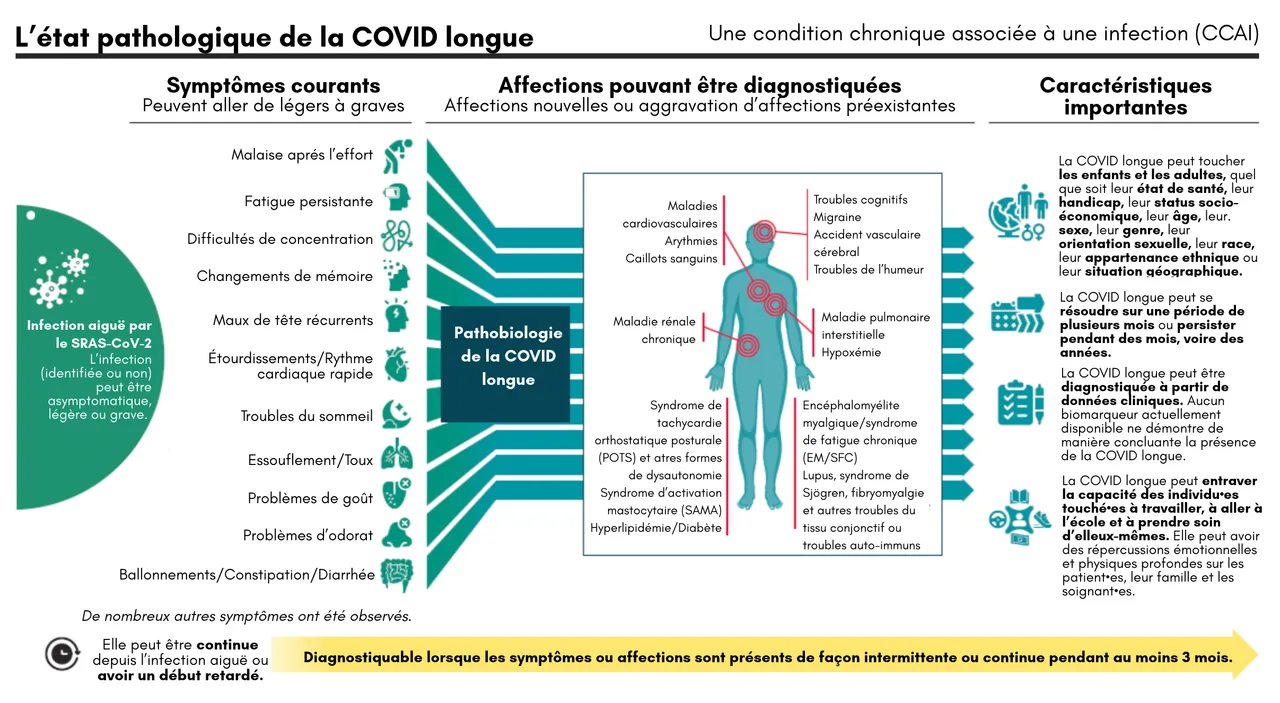
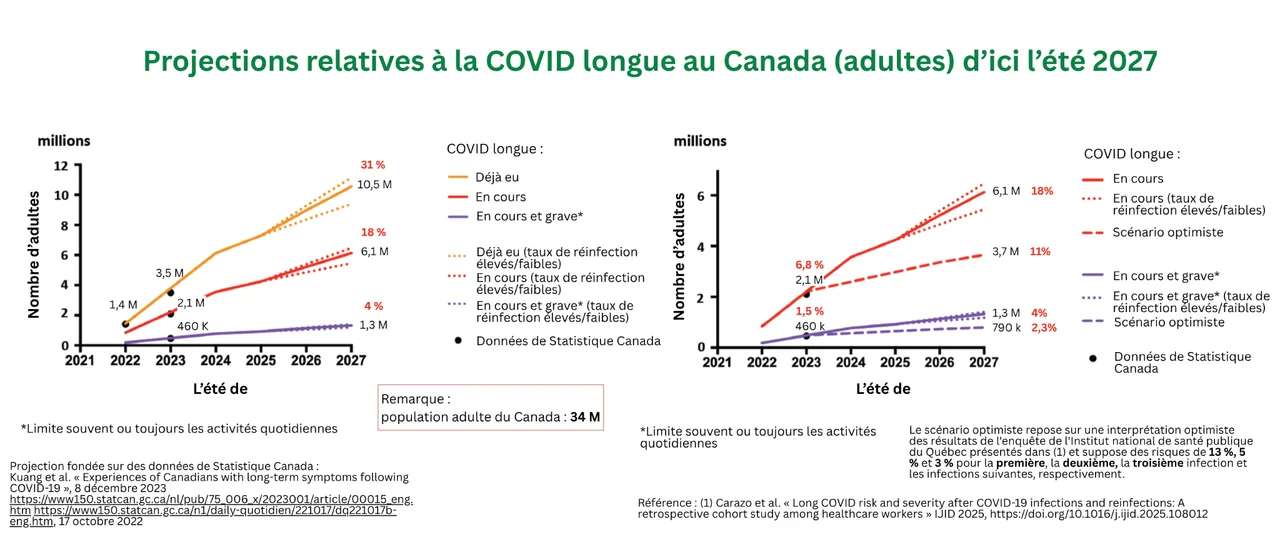
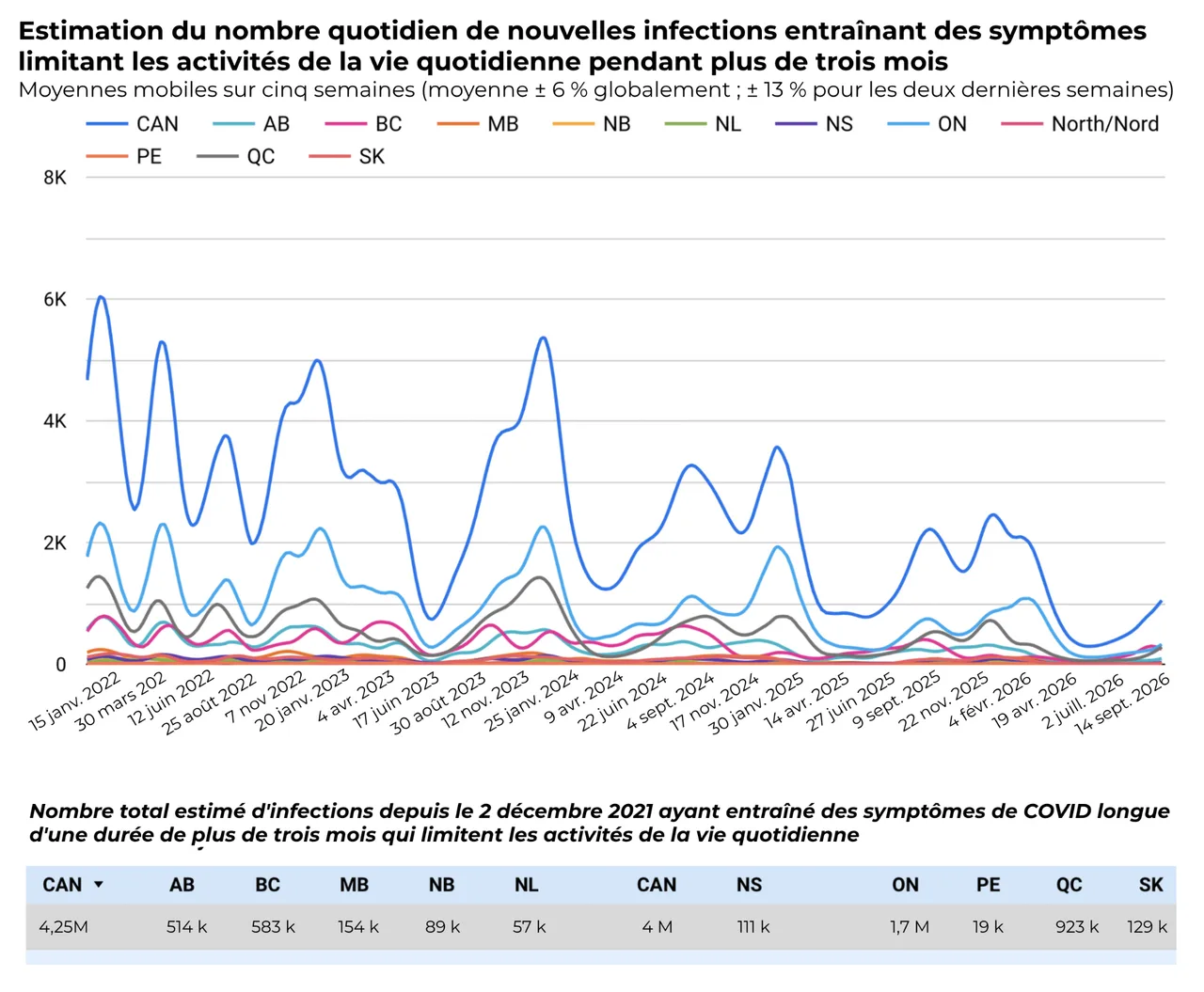
Les infections répétées à la COVID-19 sont associées à un risque accru de développer d'autres maladies graves (p. ex. crises cardiaques,Note 42 accidents vasculaires cérébraux,Note 43 démence,Note 44 maladies auto-immunesNote 45) et peuvent entraîner une invalidité à long terme.Note 46 De nouvelles recherches montrent que la COVID-19 pourrait entraîner des modifications du système immunitaire des personnes, ce qui jette un éclairage inquiétant sur la résurgence de nombreuses maladies depuis 2020.Note 47 D'ici 2023, au moins une personne canadienne sur neuf avait développé des problèmes de santé à long terme à la suite d'une infection à la COVID, un phénomène appelé « COVID longue ».Note 48 À la fin de 2023, on estimait à 400 millions le nombre de personnes touchées par la COVID longue à l'échelle mondiale.Note 49
Bien que la COVID longue soit un phénomène relativement récent, on sait depuis longtemps que de nombreuses autres maladies infectieuses entraînent des séquelles à long terme.Note 50 Cela peut se traduire par une perte de capacité de travail et des pénuries de main-d'œuvre qui ont des répercussions sur l'économie.Note 51 Une étude révèle que 46 % des personnes atteintes de la COVID longue ne peuvent pas travailler,Note 52 tandis que des données américaines indiquent 140 000 absences liées à la santé de plus par mois depuis le début de la pandémie.Note 53 Au cours de la prochaine décennie, on prévoit que la COVID longue coûtera aux pays membres de l'Organisation de coopération et de développement économiques (OCDE) 135 milliards de dollars américains par année en pertes économiques, sans compter les coûts médicaux.Note 54
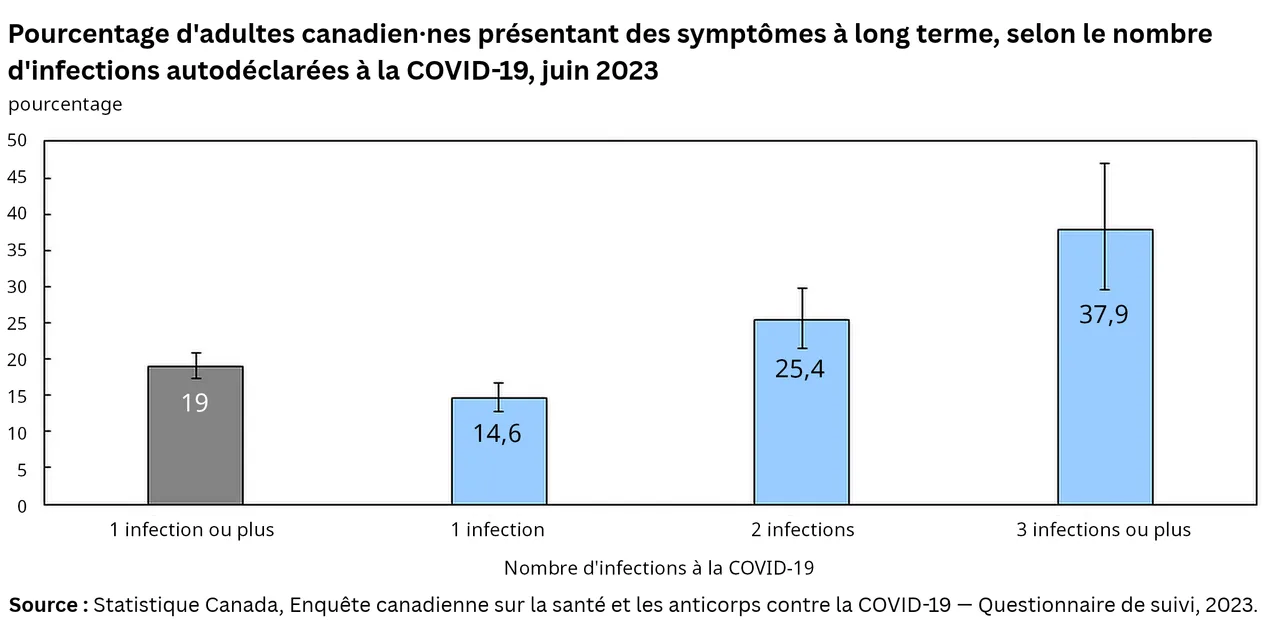
Le risque de développer la COVID longue augmente à chaque infection, touchant 37,9 % des personnes dès leur troisième infection.Note 55 Le Bureau de la conseillère scientifique en chef du Canada a qualifié la COVID longue d'événement susceptible d'entraîner une invalidité massive,Note 56 soulignant les « lacunes dans les messages publics », la nécessité de soutenir les personnes atteintes de la COVID longue et l'importance de prévenir la COVID et, par conséquent, la COVID longue, grâce à des mesures de protection (masques, air pur, isolement en cas de maladie) avec le soutien des institutions et des employeur·euses.Note 57
En savoir plus :
- Composer avec les conséquences : Le syndrome post COVID 19 et son impact continu sur les personnes et la société | Bureau de la Conseillère scientifique en chef du Canada
- La COVID longue : les réponses | Kojala Medical (en anglais)
- L'ombre persistante des épidémies : les séquelles post-aiguës à travers l'histoire | Miller et al., Trends in Immunology (en anglais)
Notes de bas de page (21)
- Andrew Nikiforuk, « As COVID Surges, the High Price of Viral Denial », The Tyee, 3 septembre 2024, https://thetyee.ca/Analysis/2024/09/03/COVID-Surge-High-Price-Viral-Denial. Retour au texte
- National Academies of Sciences, Engineering, and Medicine, A Long COVID Definition: A Chronic, Systemic Disease State with Profound Consequences (The National Academies Press, 2024), https://doi.org/10.17226/27768. Retour au texte
- « Post-Covid and Long Covid Cardiovascular Risks », Canadian Covid Society, dernière modification le 9 mars 2026, https://covidsociety.ca/priorities/long-covid/cardiovascular-risks/; Vassilios S. Vassiliou et al., « Cardiovascular Disease Prevention and Management in COVID-19: A Clinical Consensus Statement of the European Association of Preventive Cardiology, the European Association of Cardiovascular Imaging, the Association of Cardiovascular Nursing & Allied Professions, the European Association of Percutaneous Cardiovascular Interventions, and the Heart Failure Association of the ESC », European Journal of Preventive Cardiology (2025), https://doi.org/10.1093/eurjpc/zwaf540. Retour au texte
- Marco Zuin et al., « Risk of Ischemic Stroke in Patients Recovered From COVID-19 Infection: A Systematic Review and Meta-Analysis », European Stroke Journal 8, no 4 (2023) : 915–22, https://doi.org/10.1177/23969873231190432. Retour au texte
- Maxime Taquet et al., « Neurological and Psychiatric Risk Trajectories After SARS-CoV-2 Infection: An Analysis of 2-Year Retrospective Cohort Studies Including 1 284 437 Patients », The Lancet Psychiatry 9, no 10 (2022) : 816, https://doi.org/10.1016/S2215-0366(22)00260-7. Retour au texte
- Chih-Chen Tzang et al., « Association Between COVID-19 and New-Onset Autoimmune Diseases: Updated Systematic Review and Meta-Analysis of 97 Million Individuals », Clinical Reviews in Allergy and Immunology 68 (2025), https://doi.org/10.1007/s12016-025-09124-4. Retour au texte
- Hannah E. Davis et al., « Long COVID: Major Findings, Mechanisms and Recommendations », Nature Review Microbiology 21 (2023) : 134, https://doi.org/10.1038/s41579-022-00846-2; Paul A. Volberding et al., dir., Long-Term Health Effects of COVID-19: Disability and Function Following SARS-CoV-2 Infection (National Academies of Sciences, Engineering, and Medicine, 2024), 217–18, https://doi.org/10.17226/27756. Retour au texte
- Zhengqi Jiang et al., « Persistent Attenuation of Lymphocyte Subsets After Mass SARS-CoV-2 Infection », International Journal of Infectious Diseases 163 (2026) : 108287, https://doi.org/10.1016/j.ijid.2025.108287; Bernhard Kratzer et al., « Differential Decline of SARS-CoV-2-Specific Antibody Levels, Innate and Adaptive Immune Cells, and Shift of Th1/inflammatory to Th2 Serum Cytokine Levels Long After First COVID-19 », Allergy 79, no 9 (2024) : 2482–2501, https://doi.org/10.1111/all.16210; Nick Tsergas, « Why Scientists are Rethinking the Immune Effects of SARS-CoV-2 », BMJ 390 (2025) : r1733, https://doi.org/10.1136/bmj.r1733. Retour au texte
- Sianne Kuang et al., Insights on Canadian Society: Experiences of Canadians with Long-Term Symptoms Following COVID-19, catalogue no 75-006-X (Statistics Canada, 2023) : 4, https://www150.statcan.gc.ca/n1/pub/75-006-x/2023001/article/00015-eng.htm. Retour au texte
- Ziyad Al-Aly et al., « Long COVID Science », 2150. Retour au texte
- Christine M. Miller, « The Lingering Shadow of Epidemics: Post-Acute Sequelae Across History », Trends in Immunology 47, no 1 (2026) : 10–15, https://doi.org/10.1016/j.it.2025.10.010. Retour au texte
- Miguel Gallegos, « The Impact of Long Covid on People's Capacity to Work », Annals of Work Exposures and Health 67, no 7 (2023) : 801–4, https://doi.org/10.1093/annweh/wxad029; Katie Bach, « Is 'Long Covid' Worsening the Labour Shortage? », Brookings, 11 janvier 2022, https://www.brookings.edu/articles/is-long-covid-worsening-the-labor-shortage/; Kenny Cheng, « Long COVID Keeps People Out of Work and Hurts the Economy », Yale Medicine, 23 décembre 2024, https://www.yalemedicine.org/news/long-covid-keeps-people-out-of-work-and-hurts-the-economy. Retour au texte
- Céline J.A. van Bilsen et al., « Workforce Exit and Work Productivity Loss in Adults With and Without Post-COVID-19 Condition: The PRIME Post-COVID Cohort Study », International Journal of Infectious Diseases 170 (2026), https://doi.org/10.1016/j.ijid.2026.108913. Retour au texte
- Julia M. Dennett et al., « Enduring Outcomes of COVID-19 Work Absences on the US Labor Market », JAMA Network Open 8, no 10 (2025) : e2536635, https://doi.org/10.1001/jamanetworkopen.2025.36635. Retour au texte
- OECD, Addressing the Costs and Care for Long COVID: The Long Shadow of the Pandemic (OECD Publishing, 2026) : 29, https://doi.org/10.1787/87a0c171-en. Retour au texte
- Kuang et al., Experiences of Canadians, 5. Retour au texte
- Canada, Office of the Chief Science Advisor, Post-COVID-19 Condition in Canada: What We Know, What We Don't Know, and a Framework for Action (Government of Canada, 2022), 38, https://science.gc.ca/site/science/en/office-chief-science-advisor/initiatives-covid-19/post-covid-19-condition-canada-what-we-know-what-we-dont-know-and-framework-action. Retour au texte
- Canada, Office of the Chief Science Advisor, Dealing with the Fallout: Post-COVID Condition and its Continued Impact on Individuals and Society (Government of Canada, 2024), 8, https://science.gc.ca/site/science/en/office-chief-science-advisor/initiatives-covid-19/dealing-fallout-post-covid-condition-and-its-continued-impact-individuals-and-society. Retour au texte
- Kuang et al., Experiences of Canadians, 5. Retour au texte
- Malgorzata Gasperowicz, « Long COVID Projections » (présentation PowerPoint, 3rd Canadian Symposium on Long COVID, St. John's, T.-N., 21 octobre 2025); Sara Carazo et al., « Long COVID Risk and Severity After COVID-19 Infections and Reinfections: A Retrospective Cohort Study Among Healthcare Workers », International Journal of Infectious Diseases 159 (2025) : 108012, https://doi.org/10.1016/j.ijid.2025.108012. Retour au texte
- COVID-19 Resources Canada, « Canadian COVID Forecast ». Retour au texte