Measuring air quality can provide valuable information on how to make spaces safer. A variety of devices are available to measure factors like relative humidity (important for mould), fine particulate matter, a.k.a. PM2.5 (for many types of air pollution, like wildfire smoke or car exhaust), carbon monoxide, carbon dioxide, and volatile organic compounds (VOCs).
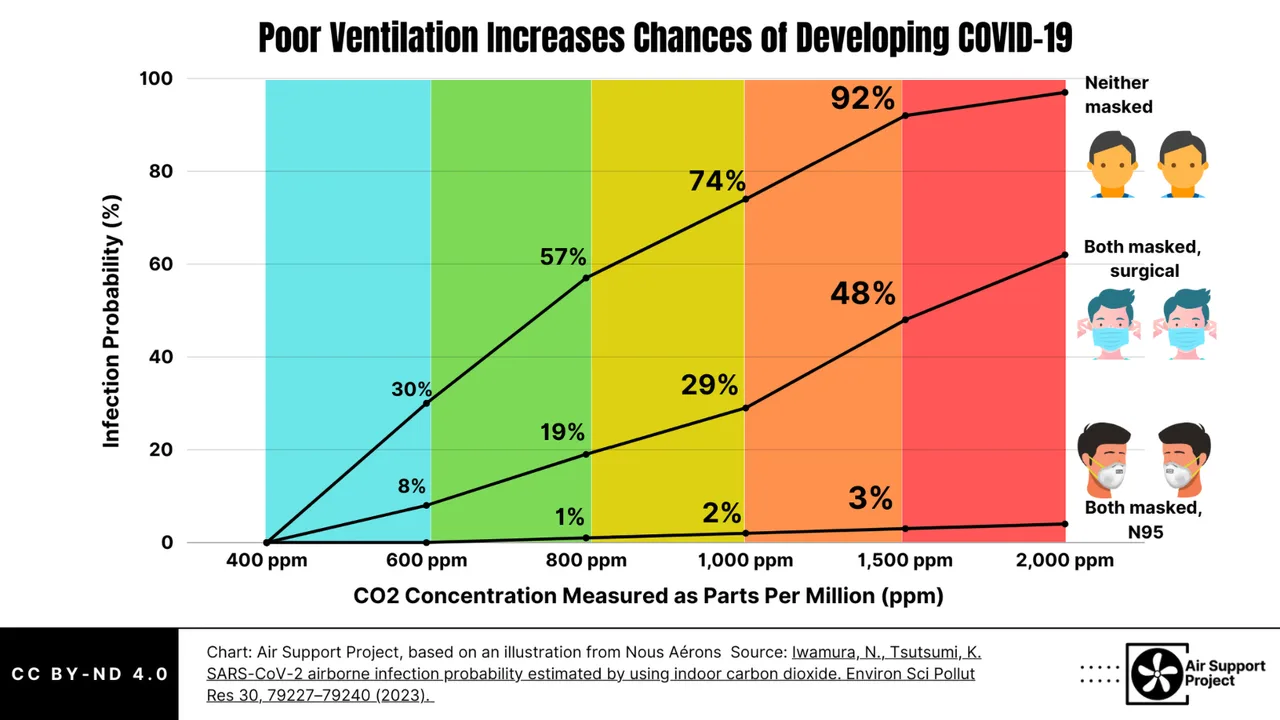
Carbon dioxide (CO2) concentration is a particularly useful metric. People release CO2 when they breathe out, so too much CO2 indoors indicates there isn't enough fresh air replacing stale air.Footnote 151 High levels of CO2 can affect people’s thinking and make them tired, dizzy, or sick.Footnote 152 It can also indicate an increased risk of airborne illnesses, because of germs in people’s recently exhaled air.Footnote 153 Many experts recommend keeping CO2 levels under 800 ppm, and aiming closer to outdoor levels (400–600 ppm) for better air quality.Footnote 154 Health Canada recommends a long-term limit of no more than 1000 ppm to reduce health risks.Footnote 155
Learn more:
- Carbon dioxide | OSPE
- Map of libraries with CO2 monitor lending programs | Community Access to Ventilation Information (CAVI)
- CO2 and its impact on COVID infection risk | Air Support Project
- What is fine particulate matter (PM2.5)? | Health Canada
See also: Risk calculators for CO2 analysis
Footnotes (6)
- Ontario Society of Professional Engineers, Special Topics in Indoor Air Quality Report: Carbon Dioxide (Ontario Society of Professional Engineers, 2025), 4, https://ospe.on.ca/wp-content/uploads/2025/05/Carbon-Dioxide-REPORT.pdf. Back to text
- Health Canada, Residential Indoor Air Quality Guidelines (Health Canada, 2021), 13–26, https://www.canada.ca/en/health-canada/services/publications/healthy-living/residential-indoor-air-quality-guidelines-carbon-dioxide.html#sec5. Back to text
- Sarah Masih et al., “The Hidden Dangers of Poor Ventilation: Understanding CO2 and its Impact on COVID Infection Risk,” Air Support Project, July 14, 2024, https://airsupportproject.com/poor-ventilation-understanding-co2/. Back to text
- Lidia Morawska et al., “Mandating Indoor Air Quality for Public Buildings,” Science 383 (2024): 1418–20, https://doi.org/10.1126/science.adl0677; OSPE, Carbon Dioxide, 7. Back to text
- “Carbon Dioxide in Your Home,” Health Canada, last modified March 19, 2021, https://www.canada.ca/en/health-canada/services/publications/healthy-living/carbon-dioxide-home.html. Back to text
- Masih et al., “The Hidden Dangers.” Back to text