When correctly and consistently worn, face masks are extremely effective in reducing spread of airborne diseases.Footnote 157 Expert consensus finds that masks combine high benefit with low life-cycle cost and low energy/carbon impact compared to other airborne illness protections.Footnote 158 Masks are effective at addressing both close-range and long-range transmission, compared to air cleaning, which is generally designed for longer distances.Footnote 159
High-filtration masks (known as respirators) can protect against many different illnesses, as well as wildfire smoke, dust, pollen, mould, and other airborne hazards.Footnote 160 They are particularly important in higher-risk circumstances (e.g., travel, wildfires, crowded indoor locations, healthcare settings, working with hazardous substances, when someone is sick or might be sick).Footnote 161
Learn more:
- Masks and respirators: state-of-the-science review | Greenhalgh et al., Clinical Microbiology Reviews
- Using a respirator mask during wildfire smoke events | Public Health Agency of Canada (PHAC)
- ARIA risk assessment tool | WHO
Types of masks
The effectiveness of a mask depends on its fit, filtering ability, and function. Common types of masks include:
Cloth masks
| Not third-party approved; effectiveness varies widely. While better than no mask, cloth generally provides less protection than other options due to poorer fit, filter ability, and fluid resistanceFootnote 162 |
|---|---|
Surgical masks
| Sometimes called procedure or medical masks; provides a barrier against larger splashes, but loose fit limits protection from smaller particles.Footnote 163 Not approved for use as respiratory protection against airborne hazardsFootnote 164 |
Respirators
| Tested and certified to protect the wearer against airborne hazards like dust, smoke, mould, or airborne illnesses; non-valved options are also extremely effective at stopping the wearer's exhaled germs (source control).Footnote 165 Some options include:
|
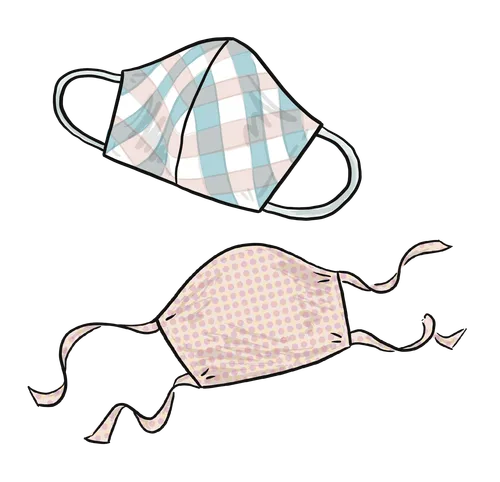
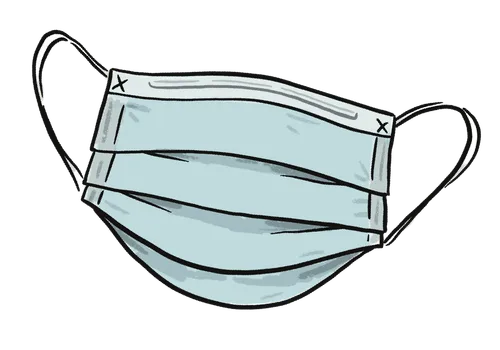
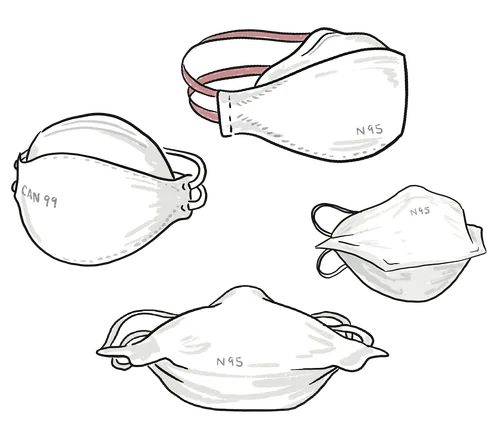
Note: A face shield is not a substitute for a mask, due to the large gaps.Footnote 166 Masks with exhalation valves protect the wearer, but don't protect others from the wearer's germs.Footnote 167
Choosing masks:
- Mask smart and Respirator factsheet | OHCOW
- Respirator selection tool | CSA Group
- Mask smart slideshow | Dr. Simon Smith
- Face coverings for COVID-19 prevention | OSPE
Get free masks:
- Masks for organizations | Canadian Red Cross
- Request free masks | Donate a Mask Canada
- Mask bloc directory | MaskBloc.Org
- Worldwide mask bloc directory | Community-maintained
Mask policies
Many people wear masks in daily life,Footnote 168 but if workers are exposed to airborne hazards in the workplace, providing respiratory protection may also be required by law.Footnote 169 In addition to these legal requirements, the Public Health Agency of Canada recommends wearing respirator masks during wildfire events,Footnote 170 and providing masks in all community settings.Footnote 171 Health Canada recommends that to reduce infectious illnesses, organizations consider “policies that require or strongly recommend people to wear a well-fitting N-95 or KN-95 respirator mask in indoor public settings.”Footnote 172
Masks can be used whether or not they are required by a public health order.Footnote 173 Research shows that policies requiring masks are more effective than optional usage,Footnote 174 and can benefit the economy by reducing disruptive closures and lockdowns.Footnote 175 Many disability justice advocates and access-centred organizations use respirator masks as a form of community care,Footnote 176 while statements from BC’s Human Rights Commissioner highlight that a lack of consistent mask requirements for COVID-19 disproportionately harms marginalized groups.Footnote 177
“Masks are most effective when worn not only by those who are [more] vulnerable to the virus but also by those who may be spreading it. Making masks optional . . . [leaves] vulnerable people with the responsibility to advocate to others for their rights and their health. This is an unjust and unnecessary burden to place on those who already bear the burden of increased risk.”
- Kasari Govender, BC Human Rights Commissioner
Learn more:
- Find your provincial or territorial OHS regulations about respiratory protection | CCOHS
- CSA standard Z94.4: Selection, use, and care of respirators (new edition coming soon) | CSA Group
- Human rights statement on mask mandates | BC Human Rights Commissioner
Accommodations and practical considerations
Not every activity supports mask-wearing, and not everyone can wear a mask.Footnote 178 All mask policies must include reasonable accommodations (without compromising safety), and wherever possible, masks should be combined with other layers of protection.
| Possible challenges | Possible solutions* |
|---|---|
| Barrier to wearing tight-fitting respirator (e.g., beard, wind instrument, medical needs, drinking) | Consider beard wraps;Footnote 179 drinking valves;Footnote 180 a loose-fitting respirator (PAPR); respirators with exhalation valves (easier breathing, but no source control); digital attendance; or exemption with other layered health & safety measures, including respirator wearing by others |
| Cost | Charities and mutual aid groups offer free N95s across Canada; discounted respirators may be available from government surplus; reusable respirators are more cost-effective over timeFootnote 181 |
| Comfort | Consider respirators with high breathability ratings; earloop, headstrap, and strapless/adhesive options; PAPRs; nose foam; “ear savers”; anti-fog glasses wipes; and outdoor mask breaks |
| Communication barriers (e.g., interruption of sign language grammar or lip reading; reduced audibility with some styles of mask) | Communication is a human need, and vital to health & safety. Many members of the Deaf and hard-of-hearing community are already disadvantaged within hearing-dominant spaces, even as some may also face structural health inequities.Footnote 182 Depending on context, and in discussion with those affected, consider options like N95-style respirators with clear windows; clear-fronted PAPRs; in-person or video remote interpreters (VRIs); captions; speech-to-text apps; microphones; communication boards; written communication; digital attendance; or exemption with other layered health & safety measures |
| Singing | Consider breathability ratings; respirator shapes that permit unrestricted jaw movement (e.g., duckbill, tri-fold, v-shaped pleats); and exemption with other layered health & safety measures. Test multiple options for individual preference; be wary of “singers’ masks” that aren't certified as respirators |
| Performance aesthetics | Respirators come in many colours, patterns, and styles. Custom-printed KN95s, loosely woven decorative mask covers, and “mask jewelry” are sometimes used for performance and cosplay |
| Uptake and audience support | Model respirator-wearing by staff and leadership; offer free masks (black or colourful respirators may improve uptake); share policies including audience code of conduct; announce, remind, and explain care- and equity-based reasons behind mask-wearing; provide adequate staffing and staff training; offer outdoor break space |
| Environmental impact | Use commercially available PPE recycling boxes; consider reusable respirators. Note that each hospital stay produces far more solid waste and carbon emissions than mask usageFootnote 183 |
* Note: Not all approaches may be approved for use in a formal workplace respiratory protection program; consult provincial/territorial regulations accordingly.
Footnotes (27)
- Greenhalgh et al., “Masks and Respirators for Prevention,” e00124-23. Back to text
- ASHRAE, ASHRAE Positions on Infectious Aerosols (ASHRAE, 2025), 20, https://www.ashrae.org/file%20library/about/position%20documents/pd-on-infectious-aerosols-english.pdf. Back to text
- ASHRAE, ASHRAE Standard 241-2023, 4. Back to text
- Public Health Agency of Canada, Using a Respirator Mask During Wildfire Smoke Events (Public Health Agency of Canada, 2024), https://www.canada.ca/en/public-health/services/publications/healthy-living/using-respirator-mask-during-wildfire-smoke-events.html; Alan Echt et al., “A Guide to Respirators Used for Dust in Construction,” NIOSH Science Bulletin, National Institute for Occupational Safety and Health, August 17, 2020, https://www.cdc.gov/niosh/bulletin/2020/respirators-construction.html; Amiel A. Dror et al., “Reduction of Allergic Rhinitis Symptoms with Face Mask Usage During the COVID-19 Pandemic,” The Journal of Allergy and Clinical Immunology: In Practice 8 (2020): 3590–93, https://doi.org/10.1016/j.jaip.2020.08.035; “Mould,” Health Canada, last modified February 13, 2026, https://www.canada.ca/en/health-canada/services/air-quality/indoor-air-contaminants/reduce-humidity-moisture-mould.html. Back to text
- “COVID-19: Travel, Testing and Borders,” Government of Canada Travel and Tourism, last modified August 8, 2025, https://travel.gc.ca/travel-covid; PHAC, Using a Respirator Mask During Wildfire Smoke Events; Public Health Agency of Canada, “Respiratory Infectious Diseases: Mask Use for Reducing the Spread,” Public Health Agency of Canada, last modified October 4, 2024, https://www.canada.ca/en/public-health/services/diseases/respiratory-infectious-diseases-reduce-spread-personal-protective-measures/masks.html; CATC, Protecting Health Through Science and Standards; British Columbia’s Office of the Human Rights Commissioner, “Human Rights Commissioner Troubled By End of Mask Mandates in Healthcare Settings,” news release, April 12, 2023, https://bchumanrights.ca/news-and-events/news/human-rights-commissioner-troubled-by-end-of-mask-mandates-in-healthcare-settings/; “Respirators — Respirator Selection,” Canadian Centre for Occupational Health and Safety, last modified August 22, 2025, https://www.ccohs.ca/oshanswers/prevention/ppe/respslct.html. Back to text
- Kristin L. Andrejko et al., “Effectiveness of Face Mask or Respirator Use in Indoor Public Settings for Prevention of SARS-CoV-2 Infection — California, February–December 2021,” MMWR Morbidity and Mortality Weekly Report 71 (2022): 212–16, http://dx.doi.org/10.15585/mmwr.mm7106e1; Greenhalgh et al., “Masks and Respirators for Prevention” e00124-23; Ontario Society of Professional Engineers, 2022 Indoor Air Quality Reports: Guidance: Face Coverings for COVID-19 Prevention (Ontario Society of Professional Engineers, 2022), 7, https://ospe.on.ca/wp-content/uploads/2024/11/Face_Covering_Guidance_Mar15.pdf. Back to text
- OSPE, Face Coverings, 7. Back to text
- “Healthcare Respiratory Protection,” National Institute for Occupational Safety and Health (NIOSH), last modified January 15, 2025, https://www.cdc.gov/niosh/healthcare/respiratory-protection/index.html. Back to text
- Jianyu Lai et al., “Relative Efficacy of Masks and Respirators as Source Control for Viral Aerosol Shedding from People Infected with SARS-CoV-2: A Controlled Human Exhaled Breath Aerosol Experimental Study,” eBioMedicine 104 (2024): 105157, https://doi.org/10.1016/j.ebiom.2024.105157. Back to text
- Canadian Centre for Occupational Health and Safety, Respiratory Infectious Diseases (RIDs): Using Face Shields (Canadian Centre for Occupational Health and Safety, 2024), https://www.ccohs.ca/products/publications/face-shields. Back to text
- Matthew Staymates, “Flow Visualization of an N95 Respirator With and Without an Exhalation Valve Using Schlieren Imaging and Light Scattering,” Physics of Fluids 32, no. 11 (2020): 111703, https://doi.org/10.1063/5.0031996. Back to text
- Steph Fowler, “Why Are People *Still* Wearing Masks?: A Mental Health Professional’s Perspective,” Misfit Mental Health, last modified May 10, 2026, https://misfitmentalhealth.substack.com/p/why-are-people-wearing-masks-in-2025; “Yes, We Continue Wearing Masks—Here’s Why: Common Questions Answered,” Word Health Network, last modified November 25, 2025, https://whn.global/yes-we-continue-wearing-masks/. Back to text
- “Respiratory Protection,” WorkSafeBC, accessed July 4, 2026, https://www.worksafebc.com/en/health-safety/tools-machinery-equipment/personal-protective-equipment-ppe/types/respiratory-protection; OSPE, Guidance: Face Coverings, 9–10. Back to text
- PHAC, Using a Respirator Mask During Wildfire Smoke Events. Back to text
- PHAC, “Respiratory Infectious Diseases.” Back to text
- Health Canada, Guidance for Indoor Air Quality Professionals (Health Canada, 2025), 12, https://www.canada.ca/en/health-canada/services/publications/healthy-living/guidance-indoor-air-quality-professionals.html. Back to text
- PHAC, “Respiratory Infectious Diseases.” Back to text
- Dhaval Adjodah et al., “Association Between COVID-19 Outcomes and Mask Mandates, Adherence, and Attitudes,” PLOS One 16, no. 6 (2021): e0252315, https://doi.org/10.1371/journal.pone.0252315; Greenhalgh et al., “Masks and Respirators for Prevention,” e00124-23. Back to text
- Jan Hatzius et al., “Face Masks and GDP,” Goldman Sachs Research, June 29, 2020, https://www.goldmansachs.com/insights/goldman-sachs-research/face-masks-and-gdp. Back to text
- Alice Wong, “COVID Isn’t Going Anywhere. Masking Up Could Save My Life,” Disability Visibility, Teen Vogue, January 17, 2024, https://www.teenvogue.com/story/covid-isnt-going-anywhere-masking-up-could-save-my-life; Fowler, “Why Are People *Still* Wearing Masks?"; Emily Dupree and Shelby Seier, “How to Make Spaces More Accessible During the Continuing Pandemic,” The Sick Times, May 23, 2024, https://thesicktimes.org/2024/05/23/how-to-make-spaces-more-accessible-during-the-continuing-pandemic; “Safer Gatherings,” People's CDC, accessed July 12, 2026, https://peoplescdc.org/safer-gatherings/; “Practicing Inclusion in the Time of COVID,” Strategies for High Impact, accessed July 11, 2026, https://www.strategiesforhighimpact.org/covid-inclusion. Back to text
- BC’s Office of the Human Rights Commissioner, “Commissioner Urges Public Health Officer.” Back to text
- Greenhalgh et al., “Masks and Respirators for Prevention,” e00124-23; Wong, “COVID Isn’t Going Anywhere”; eZme Fern, “My Child and I Both Have Long COVID. Even in COVID-Aware Spaces, We are Excluded Because of Their Pre-Existing Disability,” The Sick Times, March 7, 2026, https://thesicktimes.org/2026/03/07/my-child-and-i-both-have-long-covid-even-in-covid-aware-spaces-we-are-excluded-because-of-their-pre-existing-disability/. Back to text
- Victoria State Government, “Supporting Victoria’s Multicultural Health Workforce,” news release, September 24, 2024, https://www.premier.vic.gov.au/supporting-victorias-multicultural-health-workforce. Back to text
- Gerard Hughes, “Is It Safe to Stick a Hole in Your Mask so You Can Take a Drink? Testing the SIP Drinking Valve,” posted August 24, 2022, YouTube, https://youtu.be/tFp_PTJbEGY. Back to text
- Occupational Health Clinics for Ontario Workers Inc., All Workers Need Adequate Airborne Protection: The Rationale for Fitted Filtering Facepiece Respirators (FFR) vs. Masks (Occupational Health Clinics for Ontario Workers Inc., 2022), 11, https://www.ohcow.on.ca/wp-content/uploads/2022/01/RPE_factsheet_FINAL.pdf. Back to text
- Eva Gutierrez-Sigut et al., “Access to Information in Deaf and Hard-of-Hearing People,” PLOS One 21, no. 3 (2026): e0343904, https://doi.org/10.1371/journal.pone.0343904; Michael McKee et al., “Overcoming Additional Barriers to Care for Deaf and Hard of Hearing Patients During COVID-19,” JAMA Otolaryngology–Head & Neck Surgery 146, no. 9 (2020): 781–82, https://doi.org/10.1001/jamaoto.2020.1705; “Estimates of Coronavirus (COVID-19) Related Deaths by Hearing and Vision Impairment Status, England: 24 January 2020 to 20 July 2022,” Office for National Statistics (ONS), November 18, 2022, https://www.ons.gov.uk/peoplepopulationandcommunity/healthandsocialcare/disability/articles/estimatesofcoronaviruscovid19relateddeathsbyhearingandvisionimpairmentstatusengland/24january2020to20july2022. Back to text
- Joe Vipond, “Saving the World with the Right PPE” (PowerPoint presentation, IPAC Canada Conference, Vancouver, BC, May 30, 2023); Melany Gaetani et al., “The Carbon Footprint of Critical Care: a Systematic Review,” Intensive Care Medicine 50 (2024): 731–45, https://doi.org/10.1007/s00134-023-07307-1. Back to text